Lesson Snapshot
Learn the editing framework that transforms SAT Writing from a guessing game into a consistent, evidence-based process.
Sentence boundaries decide almost everything on SAT Writing. They decide which punctuation mark belongs between two ideas, whether a string of words is a complete sentence or a fragment, and are the underlying element of one of the most heavily tested traps in the entire section: the run-on.
Most students take sentence boundaries for granted; they learned all about them in elementary school, after all. They can feel, intuitively, when a sentence or thought sounds finished. The problem, however, is that “sounds finished” and “grammatically complete” are not the same thing, and the SAT is designed to exploit exactly that gap.
An elite score requires students to identify sentence boundaries with total precision, not vague intuition. This article breaks down how to do that quickly, reliably, and under timed conditions.
What a Sentence Boundary Is
Before we really get into how to identify sentence boundaries, let’s talk about what they are. A sentence boundary is where one clause stops and another starts. That may sound like such a simple definition that it is not particularly helpful, so let’s analyze an actual example with a practice question:
In astronomy, the term “false positive” is used to describe a signal that appears to indicate the presence of an exoplanet but is later shown to have another explanation. Like a visual illusion that may strongly resemble a real object, a false positive is not a genuine detection, ________ is a misleading signal caused by other factors.
Before we look at the answer choices, I will explain the function of the blank space in this question format. It is no coincidence that this blank is right where one clause ends and another starts. Initially, it may seem like figuring out where one clause ends and another starts is not that big of a deal, right?
But the ability to consistently do so is crucial because it determines what punctuation mark should be used.
If you are not able to consistently identify boundaries, you will not be able to consistently use the right punctuation marks.
Here are the answer choices:
Which choice completes the text so that it conforms to the conventions of Standard English?
A. however, it
B. however it
C. however; but it
D. however. It
The SAT test makers are diabolical with this question type in that they often create a set of answer choices that are almost identical, with punctuation marks being the only difference.
When the answer choices look this similar, many students feel totally overwhelmed. Understandably so!
When Boundaries questions have four nearly identical answer choices, two particular skills are required: a true mastery of punctuation rules and the ability to identify sentence boundaries.
If you truly possess the ability to quickly identify boundaries, and you have mastered punctuation rules, this type of question becomes almost automatic. However, if you do not possess these skills, this type of question often ends up in a nearly complete guess.
To master punctuation rules, check out my Punctuation Masterclass for the SAT. Keep reading this article to learn about how to identify sentence boundaries. It all starts with being able to distinguish complete sentences from incomplete sentences.
What Actually Makes a Sentence Complete:
The Fragment Trap
A fragment trap asks students to accept a piece of text that looks like a sentence but is actually missing a subject, a verb, or both.
The researchers, after analyzing thousands of samples collected over a ten-year period across five different countries.
This looks like a complete sentence. It has a clear subject (the researchers), plenty of detail, and it even sounds like something you might read in a science article. Many students stop reading there because their brain automatically fills in the missing action.
But look again. What did the researchers actually do?
Nothing. There is no main verb. The phrase after analyzing… tells us something about the researchers, but it never completes the thought. The sentence is still waiting for an action.
This shows us that the length of a sentence, or that there is “a lot happening” in a sentence, do not necessarily make it a complete sentence by default. Take a look at a corrected version:
In its simplest form, a complete sentence contains three essential elements: a subject, a verb, and a complete thought. But there is one sneaky thing that can derail this:
The Subordinating Conjunction
Look at this sentence:
Although the museum extended its hours during the festival.
It looks complete because it has a subject (the museum), a verb (extended) and it really is a completed thought, right? Well, a subordinating conjunction (the word “although” in this instance) turns the entire clause into an incomplete sentence because it needs to be attached to something else in order to form a complete thought.
Importantly, if we were to remove the subordinating conjunction, it would be a complete sentence. For example:
The museum extended its hours during the festival.
But as soon as we add the “although” it is not anymore. And that actually makes sense, because if someone said “although the museum extended its hours during the festival” you’d be waiting for more information, right?
That would clearly not feel like a completed thought, even though there technically is a completed action in the sentence.
Students who do not actively check for words like although, because, since, while, and if will frequently mistake incomplete sentences for complete sentences. These are a signal, and trained students learn to flag them automatically.
One other important note: if a clause starts with a subordinating conjunction, that clause must end in a comma that attaches it to an independent (complete) sentence. As soon as you see subordinating conjunction, you know there must be a comma in the sentence!
The Run-On Trap
The second half of this skill is basically the inverse: recognizing when two complete sentences have been incorrectly joined. This is the run-on, and it is one of the most frequently tested errors on SAT Writing.
Take this example:
The data was incomplete, the researchers had to delay the publication.
Students write like this all the time. It does not really stand out as clearly wrong. But there is a probelm: both halves of this sentence are complete sentences on their own. “The data was incomplete” is a complete sentence.
“The researchers had to delay the publication” is also a complete sentence on its own.
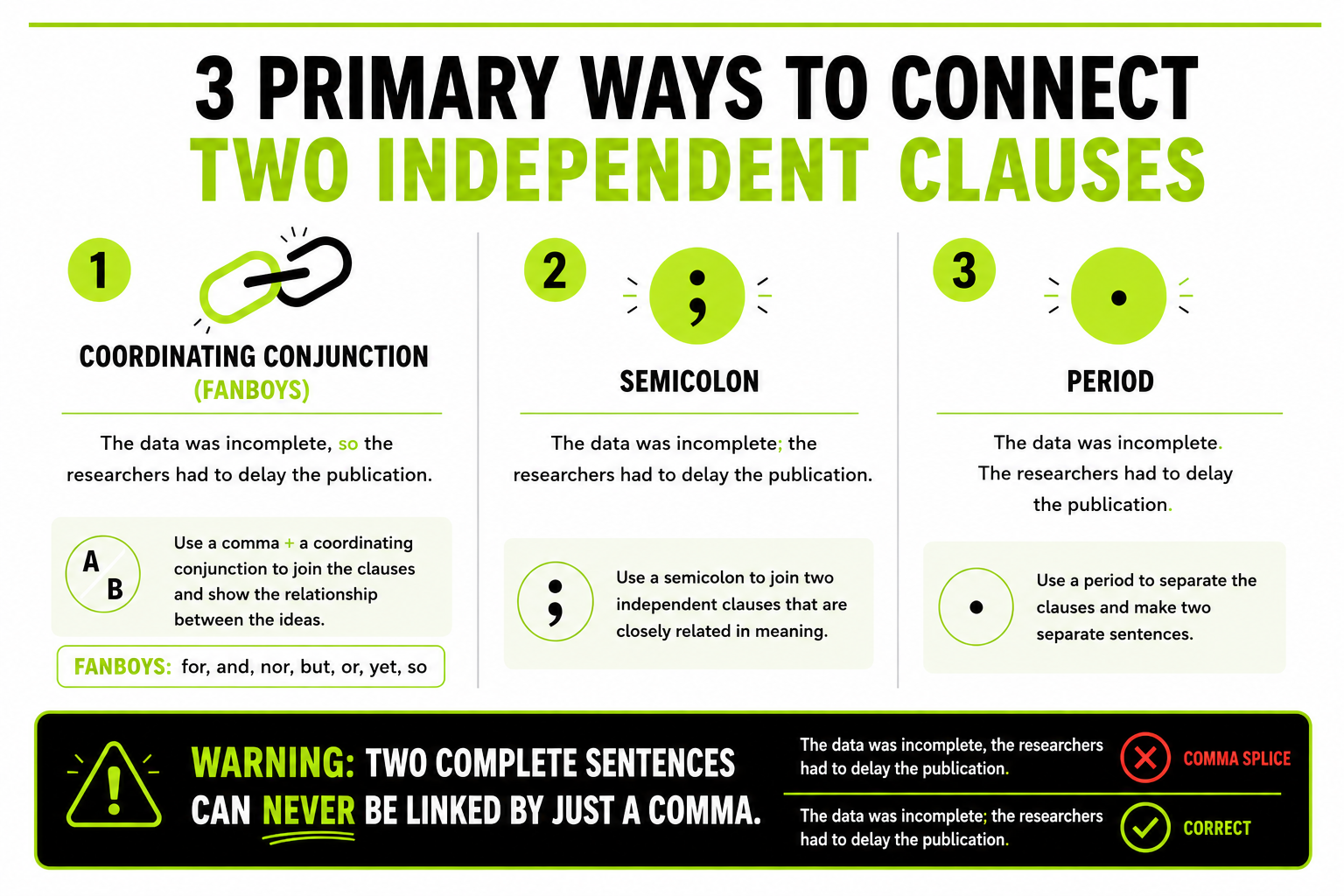
A comma alone cannot join two independent clauses. This is called a comma splice, and it is a specific type of run-on that appears constantly on the digital SAT. It will always, no matter what, be wrong.
A comma alone can never join two independent clauses. This is a crucial rule you must commit to memory!
There are three primary ways to separate two complete sentences on the SAT:
- The Coordinating Conjunction (or FANBOYS):
The data was incomplete, so the researchers had to delay the publication.
(Read more about coordinating conjunctions here)
- The Semicolon:
The data was incomplete; the researchers had to delay the publication.
(Read more about semicolons here)
- The Period:
The data was incomplete. The researchers had to delay the publication.
(Read more about periods here)

A Fast, Repeatable Method for Identifying Boundaries
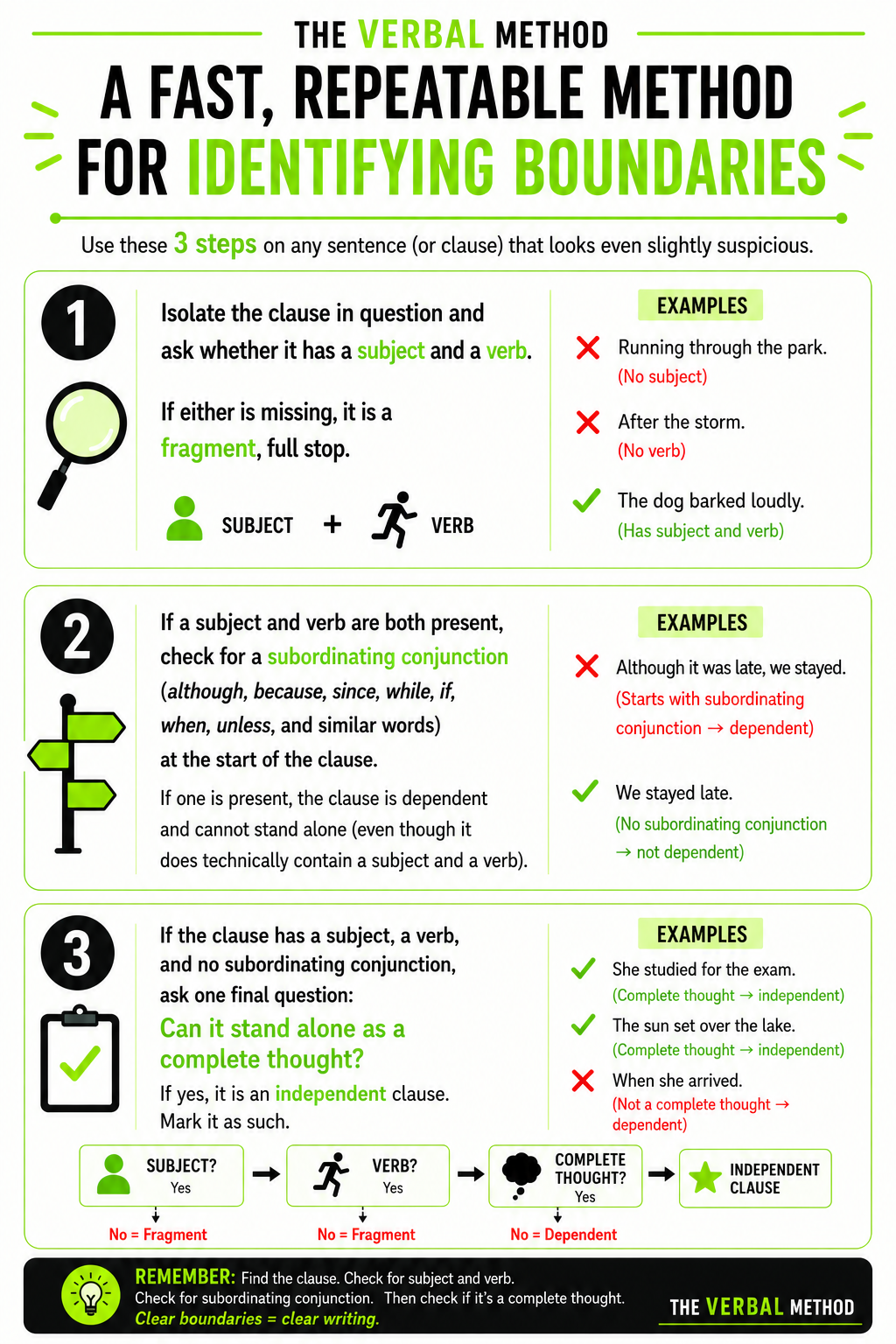
Here is the method I teach students to apply on every sentence that looks even slightly suspicious:
- Isolate the clause in question and ask whether it has a subject and a verb. If either is missing, it is a fragment, full stop.
- If a subject and verb are both present, check for a subordinating conjunction (although, because, since, while, if, when, unless, and similar words) at the start of the clause. If one is present, the clause is dependent and cannot stand alone (even though it does technically contain a subject and a verb).
- If the clause has a subject, a verb, and no subordinating conjunction, it is independent. Mark it as such.

This three-step process takes seconds once a student has practiced it enough times. The goal is not to consciously walk through these steps forever. The goal is to internalize them so thoroughly that boundary recognition becomes automatic, the same way a fluent reader does not consciously sound out each letter of a word.
A Worked Example, Start to Finish
Here is a sentence in the style of a digital SAT question:
The architect revised the blueprint twice, the client still found the design too conventional for the new development.
A student applying the method above would first notice two clauses on either side of the comma. The first clause, “the architect revised the blueprint twice,” has a subject, a verb, a completed action (and no subordinating conjunction), so it is independent. The second clause, “the client still found the design too conventional for the new development,” also has a subject and a verb and no subordinating conjunction, so it is also independent.
This is an example of two independent clauses, joined only by a comma. This is a comma splice, and the sentence is incorrect as written.
A correct revision might read:
Adding “but” after the comma supplies the coordinating conjunction (FANBOYS) needed to join two independent clauses correctly. The sentence is now grammatically sound and the contrast in meaning between the architect’s revisions and client’s continued dissatisfaction is preserved.
Building the Skill Through Practice
Like most skills tested on SAT Writing, boundary recognition improves through deliberate, repeated practice. Get in the habit of breaking down any sentence that includes multiple clauses, explicitly labeling each clause as independent or dependent before checking the punctuation. Doing this slowly and consciously at first builds the pattern recognition needed to eventually do it instantly.
Over time, this practice compounds. Once boundary recognition becomes second nature, every related rule on SAT Writing, comma usage, semicolon usage, colon usage, and conjunction placement, becomes dramatically easier to apply. This single skill is the hinge that the rest of SAT Writing punctuation swings on, and it is worth the deliberate practice it takes to master.
Test Your Boundary Recognition
In the following question (that we are revisiting from the beginning of the article), notice that the answer choices have effectively chosen the boundary for us; one way or another, the boundary will be between “however” and “it.”
The challenge lies in determining which punctuation mark we use. Remember, the first step is always to determine if each clause on either side of the boundary is a complete sentence or not. That is what will determine which punctuation mark we will use.
Answer Explanations:
A. however, it
Incorrect. Creates a comma splice. The sentence contains two independent clauses joined by only a comma. “However” cannot connect independent clauses with only a comma.
B. however it
Incorrect. Creates a run-on sentence. Without punctuation before however, the two independent clauses are fused together.
C. however; but it
Incorrect. Uses two contrasting transitions to join the same ideas. The semicolon before however is correct, but adding but afterward is redundant and ungrammatical.
D. however. It
Correct. Creates two complete sentences. However introduces the contrast between them, and it serves as the subject of the second sentence.
If you struggled at all on this question, check out my series of practice questions and video lessons specifically dedicated to Boundaries.
Master Boundaries, Then Build the Rest
Sentence-boundary questions are some of the most rule-driven questions on the SAT. Once you can reliably identify independent clauses, dependent clauses, and the punctuation that can—and cannot—connect them, these questions become far less intimidating.
If your goal is to push your SAT Reading and Writing score into the 700+ range, read The Ultimate Guide to Scoring 700+ on SAT Reading and Writing. It shows how sentence boundaries fit into the broader set of skills and strategies that high scorers use consistently.
Not sure whether boundaries are actually one of your biggest weaknesses? Take my Free SAT Reading & Writing Diagnostic Exam. It breaks your performance down by question type so you can see exactly where you’re losing points—and what to study next.
You may also want to read:
- The Three C’s of SAT Writing — A simple framework for evaluating grammar and style questions.
- The Golden Rule of SAT Reading — Why every correct answer must be supported by evidence.
- How to Avoid SAT Trap Answers — Learn the patterns behind the wrong answers designed to tempt you.
The SAT doesn’t require you to “feel” where punctuation belongs. It rewards students who can recognize the structure of a sentence and apply the correct rule.
Structure first. Punctuation second. Guessing never.


Leave a Reply