Lesson Snapshot
Learn the editing framework that transforms SAT Writing from a guessing game into a consistent, evidence-based process.
There’s a moment in every tutoring session where a student stares at a Writing question, points to an answer choice, and says: “I mean, I get what they’re trying to say.”
That sentence is the entire problem.
Most students approach SAT Writing the way they’d approach a text message from a friend, scanning for the gist, mentally smoothing over the rough patches, filling in gaps with assumed meaning. And honestly, that works fine for texting.
It does not work on the SAT Writing section, because this section is not just testing whether you can understand a sentence; it is testing whether you can fix one. It is an editing test, not a reading test.
Those are two completely different skills: understanding is passive, while editing is active, systematic, and unforgiving of ambiguity.
This difference in approach is one of the main distinctions between getting a good SAT Writing score and getting an elite SAT Writing score. So let’s talk about how this crucial SAT Writing strategy actually works.
Think Like an Editor: The Best SAT Writing Strategy
When most students read a sentence on SAT Writing, they ask one vague question: “does this sound right?”
That question is doing almost no work for you. “Sounds right” is a feeling, and feelings are exactly what the SAT is designed to exploit; the test makers intentionally write sentences that sound fine on a quick read but fall apart the moment you slow down (read more about why using intuition doesn’t work on the SAT: If You Can’t Prove It, You’re Guessing).
Conversely, a professional editor, the kind of person who actually gets paid to fix sentences for a living, never asks “does this sound right?” They ask a sequence of much sharper questions:
1. Is this grammatically correct?
2. Is this clear and concise?
3. Does this sentence logically connect to the surrounding ideas?
4. Is any word unnecessary? Does every word earn its place?
5. Is the structure consistent with the rest of the sentence and passage?
That’s a system. It’s slower than asking “does this sound right,” but it’s also why editors catch mistakes most readers miss, and exactly the mindset the SAT rewards.
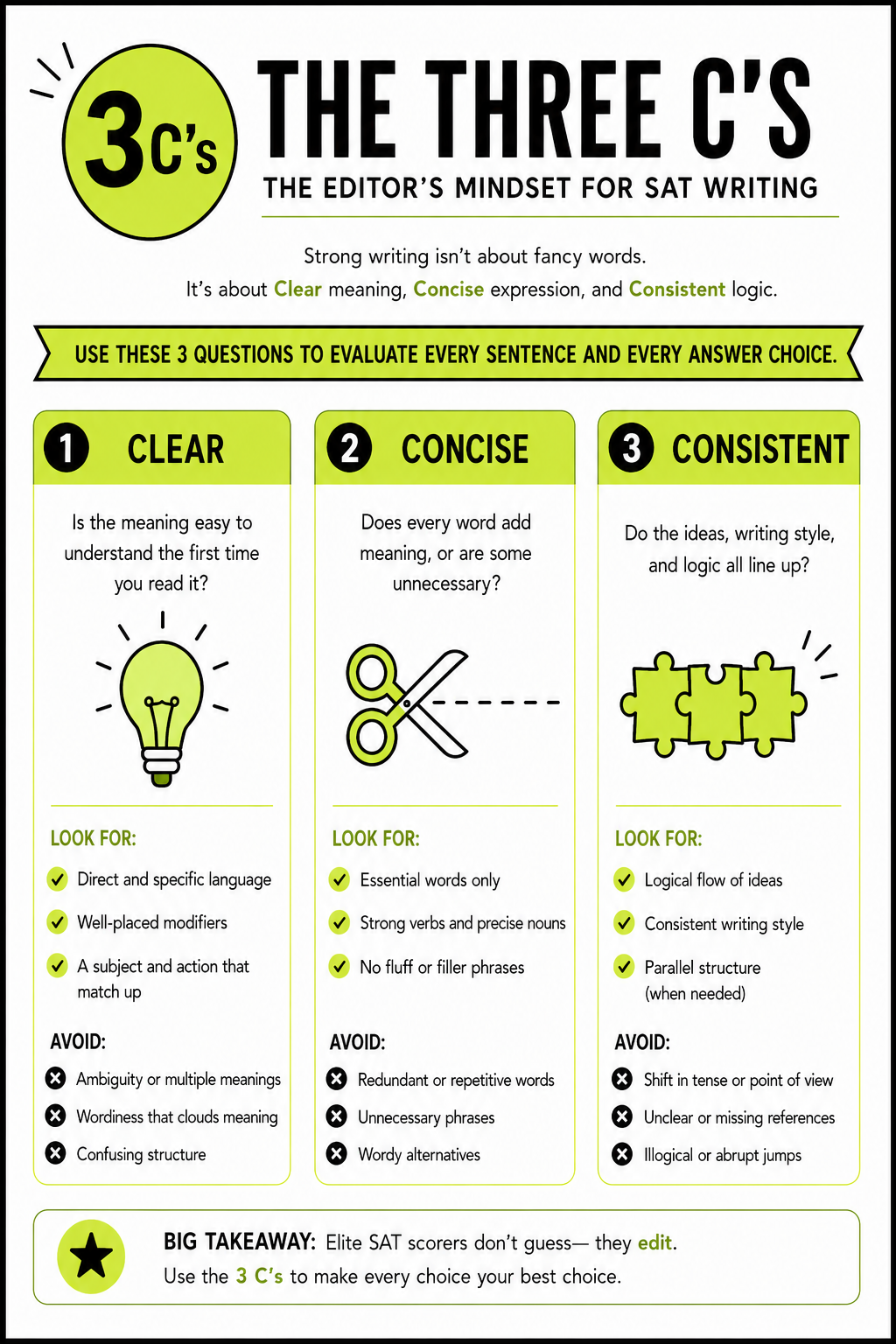
We can compress this whole editorial mindset into three rules. I call them The Three C’s: Clear, Concise, Consistent.
Almost every Writing question on the digital SAT—every comma splice, every transition error, every awkward modifier—is really just a violation of one of these three rules.

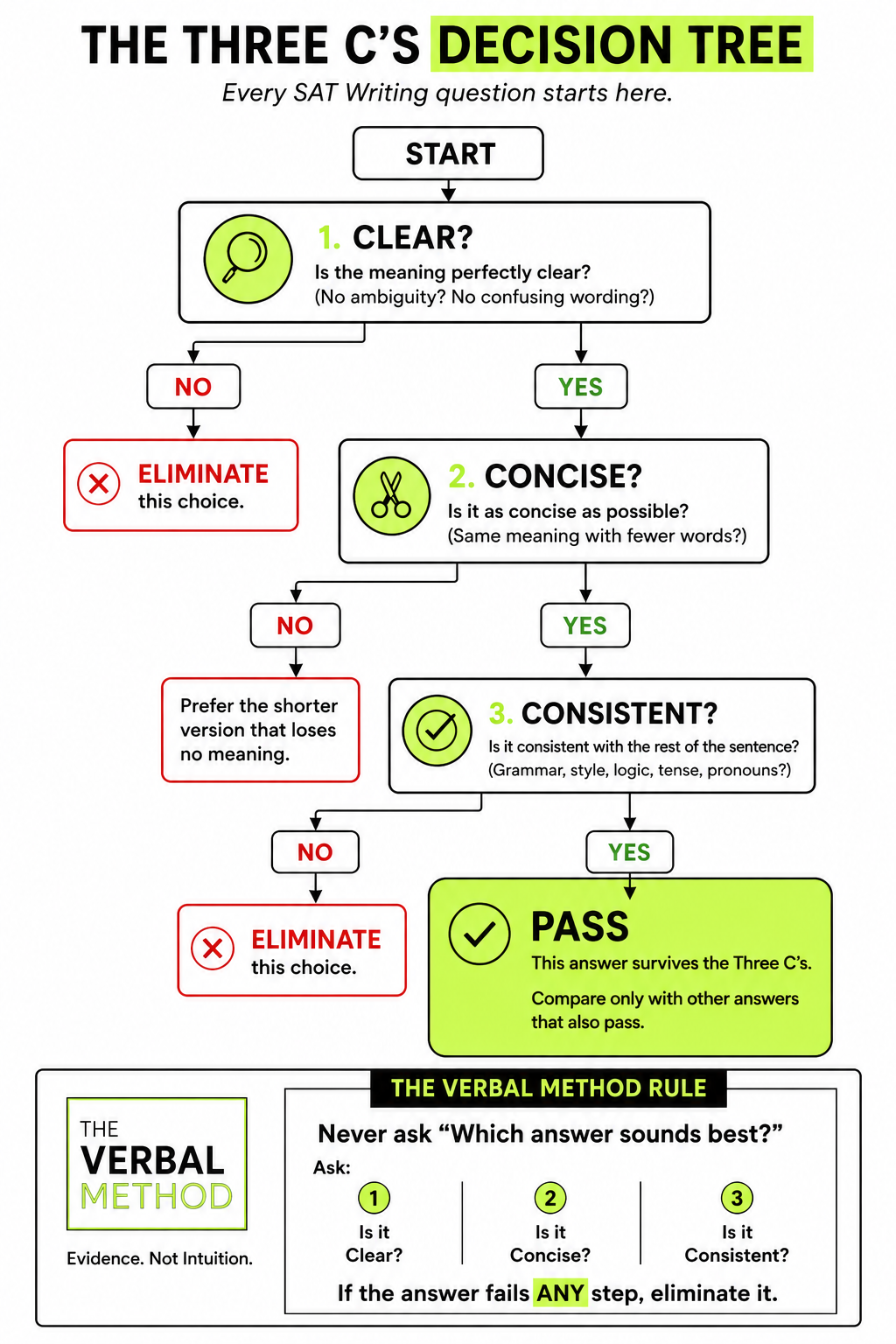
Before choosing an answer, run every option through this checklist. You’ll notice that every example in the rest of this article violates one of these three principles.
Let’s break down each one.
The Three C’s are a SAT Writing strategy that helps students evaluate every answer choice by asking whether the sentence is clear, concise, and consistent. Nearly every Digital SAT Writing question tests one or more of these three principles.
Rule 1: Clear
Every SAT Writing question starts with clarity. If the sentence isn’t clear, nothing else matters.
A sentence is “clear” when there is only one possible way to read it.
Not the most likely way. Not the way a reasonable person would assume. The only way. If a sentence allows for more than one interpretation–even if one of them is obviously what the author meant–it is not clear. And on the SAT, that is wrong.
For example:
“The scientist examined the fossil with a powerful microscope.”
Obviously we understand that the scientist was using the microscope to study the fossil, but the way this sentence is written literally suggests that it is the fossil that has a powerful microscope.
This is the exact type of ambiguity (open to multiple interpretations) that the SAT loves to test because students constantly overlook it.
Because it does not feel incorrect.
Your brain “auto-corrects” the sentence in real time, glossing over the error, because you know what the author means.
Well, the SAT is counting on exactly that reflex.
Here’s the test: if you ever catch yourself thinking “they probably mean…” or “They must mean…” you should stop right then and there.
That instinct to translate or assume is the error revealing itself. A correctly written sentence never requires translation, justifying, or “I know they are trying to say.”
It just says what it says, clearly and without any question.
Now let’s look at a few of the most common faulty mechanisms the test makers use to try to sneak subtle errors past students.
Misplaced and Dangling Modifiers
This is the most common way the SAT breaks the “Clear” rule because misplaced modifiers create sentences that are technically nonsensical while still being easily understandable to almost every reader.
Many SAT grammar questions aren’t testing only basic grammar rules. They’re testing whether you notice ambiguity.
Like the above example with the fossil and the microscope, our brain fixes it before we even notice it was broken.
Every modifier must clearly point to the word it’s describing. If readers have to guess what it’s modifying, the sentence isn’t clear enough for the SAT.
Let’s look at how this shows up in actual SAT-style Writing excerpts, where the error is buried inside a longer, more “academic-sounding” sentence, exactly how the digital SAT disguises it:
Having spent decades observing tidal patterns along the Gulf Coast, the migratory behavior of the horseshoe crab fascinated the researchers.
Read it again, slowly. The opening modifier, “Having spent decades observing tidal patterns,” needs to attach to a person, because only a person can “spend decades observing” something. But the noun immediately following the comma is “the migratory behavior,” not “researchers.”
As written, the sentence claims that the migratory behavior itself spent decades watching tides, which is obviously nonsensical. But, readers will know what the author meant, and therefore, often make the correction in real time, never even noticing the error in the first place.
The fix didn’t change the meaning, it just relocated the noun that the modifier was actually describing. That’s the whole game with modifier errors: nothing about the meaning changes, only the structure of the sentence. Read more about how the SAT tests faulty usage of modifiers in this article: How the SAT (Mis)uses Modifiers to Trick Students.
Pronoun Ambiguity
Clarity also breaks down when a pronoun could plausibly point to more than one noun:
When the curator finally spoke with the donor about the painting, she revealed that it had been misattributed for nearly a century.
Who is “she,” the curator or the donor? Grammatically, either reading works, which means the sentence fails the “Clear” test even though most readers would just guess “probably the curator” and move on. Again, there can be no guessing; it must be totally clear!
Stylistically, it is slightly less elegant to repeat “the curator,” yes. But it is also unambiguous, which on the SAT always wins.
Subject-Verb and Pronoun-Antecedent Disagreement
The title of this type of error sounds far more complicated and “grammar-y” than it actually is; disagreement errors are actually quite straightforward, especially once you’re looking for them.
The trick of it is that the SAT likes to hide the true subject behind a long phrase so the reader is more likely to lose track of it.
Example:
The collection of rare manuscripts, donated by an anonymous benefactor in the early 1960’s, were moved to the university’s new archive last spring.
Your ear hears “manuscripts … were” and it sounds fine, because “manuscripts” is plural and sits right before the verb, right?
But the actual subject is “the collection,” and everything between “collection” and “were” is just a modifying phrase (aka words that provide information/context about the actual subject of “the collection”). Consequently, the verb should be the singular “was,” not the plural “were.”
This is a textbook example of the test makers trying to sneak a subtle error past you; if the sentence were simply “the collection were moved…” just about every test student would immediately catch that obvious singular vs. plural disagreement.
But as soon as the additional information about the collection being donated is added, that disagreement between “collection” and “were” becomes much less obvious.
Much of correcting this type of error comes down to being able to consistently identify the actual subject in the intentionally long, complex sentences that the SAT test makers love.
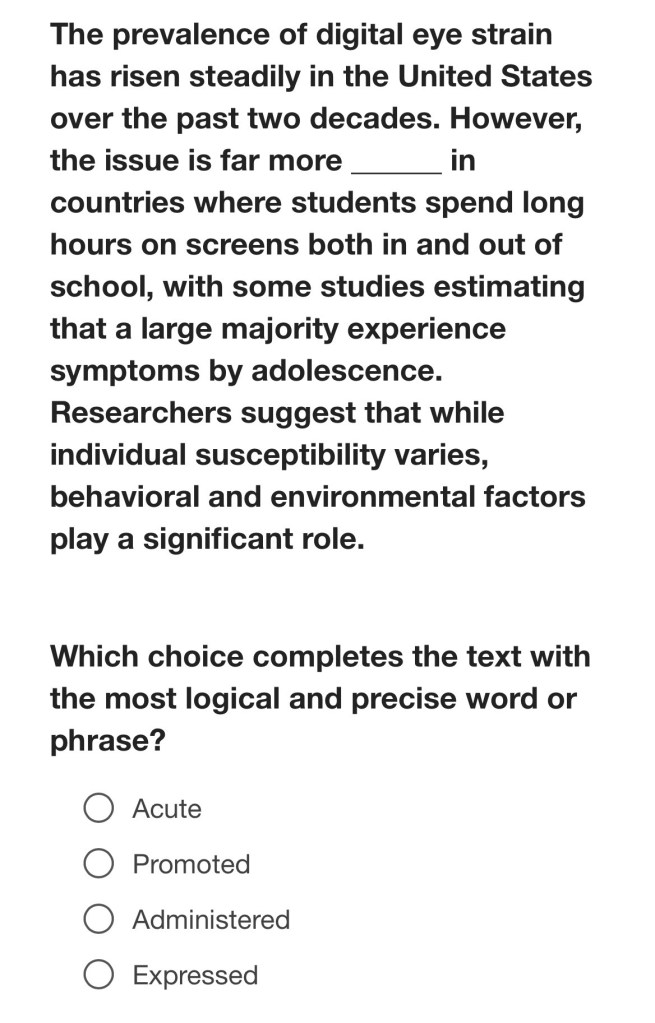
This is what this question would look like on test day:
This is why reading for “what sounds right” fails you specifically on disagreement errors. The SAT engineers these sentences so the wrong answer sounds just as natural as the right one.
Those were just three of the most common mechanisms through which the SAT test makers try to sneak this type of subtle “Clear” error past test takers. Click here to read a longer and more in-depth analysis of the most common trap answers.
Rule 2: Concise
Concise means saying everything the original sentence needs to say, using the fewest possible words.
This rule often gets oversimplified into “shorter answer is usually correct,” which is true often enough to be a useful tiebreaker between two similar answers, but dangerous as a rule on its own. Read more about this with our article When Is the Shortest SAT Writing Answer Correct?
The SAT will absolutely bait you with an answer choice that’s short only because it deleted meaning, not because it cut out unnecessary words. There is a big difference between those two things.
That is to say, if an answer choice cuts out so much information that it changes the meaning of the sentence, it cannot be correct. Your job on SAT Writing is to optimize written excerpts, not to change the meaning of them.
You should play the role of an editor who cleans up errors while maintaining the original meaning, not a co-author who has liberty to change the meaning.
Consider the following example:
Despite the fact that the bridge had been inspected just one year prior, engineers nevertheless still discovered significant structural decay.
This is the type of excerpt that causes students trouble because there are no obvious errors in it. After all, there are no glaring grammatical issues, and the meaning is clear and unambiguous. It seems fine. But there are, indeed, multiple issues here.
Look how many words in this excerpt do not actually add any meaning; several words could be removed and the sentence would not lose any meaning at all. That is a sure sign that a sentence is not written concisely enough. Let’s take a closer look:
“Despite the fact that” is unnecessary; “despite” does the same job alone. “Nevertheless” effectively has the same meaning as “despite.” This is redundant stacking, a favorite SAT trick. Take a look at a tightened version:
Same meaning, but half the clutter.
Now here’s the version that punishes students who over-apply “shorter is better” as a default rule:
The committee, after considering input from residents, local business owners, and city planners over the course of several contentious public meetings, voted to delay the proposal.
A wordiness-hunting student sees that long modifying phrase and wants to gut it down to something like:
The committee, after considering input, voted to delay the proposal.
This is shorter, therefore it can be tempting. It is also wrong, however, because it alters the actual meaning of the sentence (who gave input, and the fact that the process was difficult) rather than just trimming redundant phrasing.
Concise doesn’t mean minimal. It means no wasted words, which is a different standard entirely. A genuinely concise edit only tightens phrasing without erasing meaning.
With that insight in mind, check out a better revised version:
Notice what got cut: “local” (redundant with the implied local context) and “the course of.” Notice what stayed: every party named, the contentiousness, the number of meetings. These are important details that add meaning to the sentence and, therefore, should not be removed.
In short, some of the hardest SAT grammar questions reward concise editing rather than mere rule memorization.
Before getting rid of a word, make sure the original meaning and nuance of the sentence are not lost. with the word removed
Rule 3: Consistent
This is the rule students often forget about because it’s invisible if you’re only checking grammar. An answer choice can be flawless on subject-verb agreement, contain zero modifier errors, and still be wrong because it sounds like it wandered in from a different document.
The SAT Writing passages are almost always written in a formal, academic style: When the test offers an answer choice that’s grammatically clean but conversational, it is a problem:
Original passage tone: “Although the experiment’s initial results were promising, subsequent trials revealed significant inconsistencies in the data.”
Answer choice being tested: “But the next few times they tried it, things got pretty messy with the numbers.”
Grammatically? That second sentence is fine; the syntax holds together, and there are no grammatical errors. But even still, it is wrong.
Why? Well, because a phrase like “things got pretty messy” doesn’t belong anywhere near a sentence that was originally written as “significant inconsistencies in the data.”
Here’s a subtler version, the kind that actually shows up on hard digital SAT questions:
The biographer’s portrait of the senator is unflinching, revealing a man whose public idealism often clashed with his private dealings, which, frankly, were kind of shady.
Everything before the comma is doing serious, literary work: “unflinching,” “clashed,” “private dealings.” Then “which, frankly, were kind of shady” shows up like it walked in from a group chat. The grammar is fine. The style is not.
Consistency is the rule that separates students who “know grammar” from students who actually read like editors, because it requires you to track the tone of a passage, not just the rules inside a single sentence.
Putting the Three C’s Together
Here’s why this framework matters more than any individual grammar rule; Every Writing question on the SAT can be diagnosed by asking these three questions:
1. Is there more than one interpretation of this and are there any errors that need to be fixed? (Clear)
2. Is every word necessary? (Concise)
3. Does this match the tone of everything around it? (Consistent)

Most students’ instinct is to ask “does this sound right?” a single, vague question that the SAT is specifically engineered to exploit.
The students who score 700+ have, consciously or not, replaced that vague question with something far more systematic.
They don’t read faster. They read more precisely, asking sharper questions in a fixed order, the same way an editor reads a manuscript before it goes to print.
Whether you’re aiming for a 700+ SAT Writing score or simply trying to stop guessing on SAT grammar questions, the Three C’s give you a repeatable system for approaching every Digital SAT Writing question with confidence.
The good news is that this is a learnable habit, not an innate gift. So the next time you hit a Writing question and feel that pull toward “I know what they mean,” treat it as a red flag.
In that moment, ask if any of the Three C’s are being violated. Once you start seeing sentences this way, you can’t really go back to reading them the old way. And that is the point; after years of tutoring SAT Reading and Writing, I’ve found that almost every difficult Writing question can be reduced to one of these three principles.
Frequently Asked Questions:
What is the best SAT Writing strategy?
The best SAT Writing strategy is to think like an editor, not a test-taker. Instead of asking what “sounds right,” ask whether the sentence is clear, concise, and consistent. That simple framework works on nearly every SAT Writing question.
Is SAT Writing mostly grammar?
Not quite. Grammar matters, but many SAT Writing questions test your ability to edit a sentence for clarity, concision, and style. Strong grammar helps, but a systematic editing process matters even more.
Should I always choose the shortest answer on SAT Writing?
No. Choose the answer that says everything it needs to—and nothing it doesn’t. The shortest answer is often correct, but only when it preserves the original meaning and removes unnecessary words.
How do I improve my SAT Writing score?
Stop relying on intuition. Learn the grammar rules the SAT tests most often, then practice applying them with a consistent editing process. The more patterns you recognize, the less you’ll have to guess.
What grammar rules are tested on the SAT?
The SAT repeatedly tests the same core concepts: subject-verb agreement, pronouns, modifiers, punctuation, transitions, sentence boundaries, and concision. Master those patterns, and you’ll be prepared for the vast majority of SAT Writing questions.
Ready to Put the Three C’s Into Practice?
The Three C’s—Clear, Concise, and Consistent—give you a repeatable way to approach SAT Writing questions like an editor instead of relying on what simply “sounds right.”
But they’re only one piece of a much larger system.
If your goal is to break into the 700+ range on SAT Reading and Writing, start with [The Ultimate Guide to Scoring 700+ on SAT Reading and Writing]. It walks through the broader strategies, habits, and decision-making skills that separate strong scorers from students who continue to lose points on avoidable mistakes.
Not sure what’s actually holding your score back? Take my [Free SAT Reading & Writing Diagnostic Exam]. It’s designed to identify the specific question types and reasoning patterns costing you points so you know exactly what to work on next.
You may also want to read:
- How to Avoid SAT Trap Answers: 8 Common Wrong Answer Patterns Explained — Learn why tempting wrong answers work and how to eliminate them with evidence instead of intuition.
- Stop Trying to Understand 100% of the SAT Reading Passage — A more efficient approach to reading dense SAT passages without wasting time chasing perfect comprehension.
- The Golden Rule of SAT Reading — If you can’t prove an answer from the text, you’re guessing.
The goal isn’t to memorize hundreds of isolated SAT tricks. It’s to build a small number of repeatable processes you can trust under pressure.
Evidence, not intuition. Process, not guesswork.


Leave a Reply