There’s a moment almost every SAT student knows.
You read the question. You go back to the passage. You immediately eliminate two answer choices that are clearly off. And then you’re left staring at the final two.
Both seem reasonable. Both sound intelligent. Both feel like they could be right.
And what should have taken twenty seconds turns into a minute-long internal debate that you eventually resolve with what feels like a coin flip.
Here’s what most students don’t realize: one answer is defensibly correct, while the others are merely plausible enough to tempt students who are not precise enough with their usage of textual evidence.
That’s how standardized assessments work. To reliably distinguish between students, the test needs wrong answers that appeal to common reasoning mistakes, not obviously ridiculous choices that everyone can eliminate immediately.
Generally speaking, the test makers don’t so much trick you with difficult questions as much as they trick you with answer choices that are deceptively close to being right. As a result, understanding how those trap answers are built is one of the highest-leverage skills you can develop for SAT Reading and Writing.
After years of working with high-performing students stuck in the 600s, I’ve found the same trap patterns appear again and again, and that’s the good news; once you learn to recognize these patterns, trap answers begin to stand out.
What is a trap answer on the SAT?
A trap answer is a wrong answer choice designed to seem plausible by subtly distorting the passage through exaggeration, unsupported inference, scope shifts, or misleading wording.
Why Trap Answers Exist
Trap answers are not primarily designed to catch students who completely failed to comprehend the passage. Those students often eliminate themselves more obviously.
The more sophisticated trap answers are designed to catch students who understood the general idea but answered imprecisely because they answered from their general impression, not directly from textual evidence.
This is because SAT Reading and Writing is not asking what interpretation seems reasonable, sophisticated, or plausible. It is asking which answer choice is best supported by the text.
That distinction matters a lot.
A strong student may correctly grasp the author’s general point, tone, or argument, then select an answer that feels intellectually consistent with that understanding, but is not actually what the passage specifically supports.
This is exactly where many trap answers live: answer choices that are broadly compatible with a student’s impression of the passage, yet fail under close evidentiary scrutiny.
That the SAT is built this way is no accident.
As a standardized assessment given to millions of students, the test must prioritize reliability, consistency, and defensibility in scoring.
For that to happen, one answer choice must be clearly more correct than the other three. If multiple answers could reasonably be defended based on subjective interpretation, the test would no longer function as a reliable objective assessment. As a result, the SAT is designed to reward textual evidence.
Quite often the problem isn’t that students don’t understand the passage. The problem is they haven’t trained themselves to recognize how the SAT test makers engineer misleading answer choices.
The good news is that wrong answer choices tend to fall into recurring patterns. That means trap answers aren’t just avoidable; they become predictable once you understand the patterns.
Here are eight common trap answer types you’ll encounter, with examples of each. Note that these are brief explanations of each trap answer type and that The Verbal Method’s self-paced curriculum has numerous video lessons and dozens of practice questions with thorough video explanations. Read more about how to master SAT Reading and Writing trap answers with this course.
8 Common SAT Trap Answer Types (And How to Beat Them)
Trap #1: The Partially Correct Answer
What it is:
An answer that gets most things right, but contains one fatal flaw. One wrong detail. One subtle overstatement. One quiet shift in meaning.
This is the most common trap on the entire SAT, and it’s the one that hurts strong students most.
Why? Because when students scan an answer choice and recognize accurate information, they stop reading critically. The familiar details create a sense of confirmation, and the one disqualifying element slips past.
Example:
Passage says: “Several researchers have proposed that sleep deprivation may contribute to decreased cognitive performance.”
Trap Answer: “Researchers have concluded that sleep deprivation causes lowered cognitive output.”
Correct Answer: “Some researchers have suggested a possible link between sleep deprivation and reduced cognitive function.”
Why it is wrong:
The trap answer creates an unwarranted implication of consensus by changing “Several researchers” from the passage to simply “researchers.” The passage explicitly says only “several” researchers, not all. This subtle omission of one word is easy to miss when moving quickly, but it does meaningfully change the meaning of the text.
The trap answer also has a change from a tentative claim (“may contribute”) to a definitive causal claim (“causes”). Again, a seemingly subtle change makes a real difference in the meaning of the answer choice.
Even the switch from “proposed” to “concluded” adds another unwarranted element of definitiveness, well beyond the scope of what the passage actually says.
When we add up all those subtle changes, we can clearly see how the trap answer’s characterization of the passage excerpt is far too strong. It changed a proposed claim from a small group of researchers that sleep deprivation might impair cognitive function into a statement that all researchers have proven that sleep deprivation impairs cognitive function.
How to Beat it:
Before selecting any answer, ask yourself: is every word in this answer supported by the passage? Not most words. Every word. Is there any word that is stronger than what the passage actually says? Is there any disqualifying element?
Trap #2: The Plausible-but-Unsupported Answer
What it is:
An answer that sounds intelligent, reasonable, and sophisticated, but the passage never actually says it.
This one is particularly dangerous for strong students, because it preys on their ability to think analytically. They read the passage, make a logical inference, and then select an answer that matches that inference, even though the passage itself never actually supports it.
SAT Reading rewards disciplined, evidence-based reasoning, not intuition or plausibility. If an answer choice is not in the passage, it is not correct, no matter how reasonable, sophisticated, or “right” it sounds.
Example:
Passage says: “The industrial revolution dramatically accelerated urbanization across Western Europe.”
Trap Answer: “The industrial revolution improved living standards for European workers.”
Correct Answer: “The industrial revolution significantly increased the rate at which people moved to cities in Western Europe.”
Why it is wrong:
The trap answer is a very reasonable real-world inference. Many people do associate industrialization with eventual improvements in living standards. It makes perfect sense and, honestly, is almost certainly true. But the passage says nothing about living standards; it talks about urbanization.
The trap answer is completely reasonable, likely true, and sounds like something a highly intelligent person would say. That’s precisely why it’s there, and why it is so tempting.
How to Beat it:
Ask yourself: did the passage actually say this, or does it just seem consistent with what the passage said? Evidence, not vibes.
Trap #3: The Extreme Language Trap
What it is:
An answer that uses absolute language the passage never justifies.
Watch for words like:
• always / never
• completely / entirely
• only / exclusively
• proves / guarantees
• all / none / every
SAT passages are almost always written with careful hedging: “some,” “many,” “often,” “suggests,” “may.” When an answer choice uses language that is dramatically stronger than the passage warrants, that’s a red flag. Very rarely is absolute language correct!
Example:
Passage says: “In most cases studied, early childhood exposure to music was associated with stronger language development.”
Trap Answer: “Music exposure always produces superior language skills in children.”
Correct Answer: “Research suggests that early music exposure is often linked to better language development.”
Why it is wrong:
The trap answer takes a carefully qualified finding and strips away every qualification by changing “most cases” to “always” as well as “associated with” to “produces.” Think about how much more difficult it would be to prove a claim is always true rather than “usually” or “often” true. That is exactly why test takers should be wary of absolute language.
How to Beat it:
When you see extreme language in an answer choice, go back and verify that the passage actually uses language that strong. It usually doesn’t.
Already recognizing these mistakes in your own SAT practice?
Take The Verbal Method’s free SAT Reading & Writing diagnostic and pinpoint your exact weak spots before test day with a breakdown by question type, skill category, and trap-answer pattern.
Trap #4: The Outside Knowledge Trap
What it is:
An answer that is factually accurate in the real world, but isn’t supported by the passage.
This trap especially trips up high-achieving students because their well-developed outside knowledge makes irrelevant trap answers look correct.
The SAT doesn’t care what’s true in the real world. It only cares what’s true in the passage.
Example:
Passage says: “The author argues that urban green spaces improve residents’ reported sense of wellbeing.”
Trap Answer: “Green spaces reduce urban air pollution, which contributes to residents’ health.”
Correct Answer: “According to the author, access to green spaces in cities is associated with residents feeling better.”
Why it is wrong:
The trap answer is plausible and even scientifically valid: green spaces do help with air quality. But the passage doesn’t say that. It talks about wellbeing and residents’ self-reported experience. The trap imports real-world knowledge that the text never introduces.
How to beat it:
Remind yourself before each question: my only source is this passage. Everything else—everything you know, everything you’ve learned, everything that seems true—is irrelevant
Trap #5: The Scope Shift Trap
What it is:
The answer subtly shifts what the passage actually claims.
The passage might discuss one study → the answer generalizes to all of science.
The passage makes a broad point → the answer zeroes in on one specific detail.
The passage talks about a trend in one country → the answer says it applies globally.
Scope shifts are hard to catch because the answer isn’t technically wrong about the content; it’s wrong about the scale of the claim.
Example:
Passage says: “A 2019 study of elementary school students in Finland found that outdoor learning improved attention spans in the classroom.”
Trap Answer: “Outdoor learning has been shown to improve academic outcomes for students worldwide.”
Correct Answer: “Research conducted in Finland suggests that outdoor learning may benefit younger students’ ability to focus in school.”
Why it is wrong:
One study in one country with elementary school students became a universal global claim about all students and all academic outcomes. Every word of that expansion is unsupported.
How to beat it:
Compare the scope of the answer to the scope of the passage. Ask: did the passage make this broad of a claim, or is this answer changing the scope?
Trap #6: The Wrong Relationship Trap
What it is:
The answer uses accurate details from the passage but connects them in a way the passage never actually supports.
This is one of the most dangerous SAT traps because nothing in the answer looks obviously false. The facts are real. The vocabulary is familiar. The concepts genuinely appear in the text. Just about everything in this trap answer type looks right, except for the fact that an error lies in the relationship between those ideas.
Common versions:
- Reverses cause and effect (A led to B → trap says B led to A)
- Flips a comparison (A outperformed B → trap says B outperformed A)
- Swaps perspectives (the critic argues X, the researcher argues Y → trap assigns views incorrectly)
- Converts contrast into agreement (although A, B → trap implies because A, B)
- Confuses correlation with causation (A occurred alongside B → trap says A caused B)
Example:
Passage: “Although early exposure to multiple languages is associated with stronger executive functioning in children, researchers caution that the relationship is correlational; households that raise multilingual children may also differ in educational resources, parental involvement, or other factors that independently influence cognitive development.”
Trap Answer:
“Researchers conclude that multilingual exposure directly improves executive functioning because children in multilingual households receive greater cognitive stimulation.”
Correct Answer:
“Researchers note an association between multilingual exposure and executive functioning, while emphasizing that other household variables may help explain the relationship.”
Why it is wrong:
This trap is especially effective because nearly every individual piece sounds legitimate.
The passage mentions:
✔ multilingual exposure
✔ executive functioning
✔ household differences
✔ cognitive development
But the trap quietly commits two relationship errors:
- It turns correlation into proven causation.
The passage explicitly warns against assuming multilingual exposure directly caused the outcome. - It invents a causal mechanism (“greater cognitive stimulation”) that sounds reasonable but is never actually stated.
This is exactly how advanced SAT traps work: they assemble real components into a false conclusion.
How to beat it:
When an answer choice combines multiple accurate details, do not ask, “Did I see these words?”
Ask: “Did the passage connect these ideas in this exact way?”
On tougher questions, the SAT often doesn’t lie about the facts. It lies about the logic connecting them.
Trap #7: The Keyword Echo Trap
What it is:
An answer that repeats exact words or phrases from the passage, but uses them to say something the passage never actually said.
This is a psychological trap as much as a logical one. When students see familiar language in an answer choice, they feel a sense of recognition. I saw those words. This must be right.
Example:
Passage says: “The architect described the building as a response to the community’s need for accessible public gathering spaces.”
Trap Answer: “The architect designed the building to address the community’s interest in creating more public gathering spaces.”
Correct Answer: “The architect designed the building to serve as a public space that community members could easily use.”
Why it is wrong:
The trap stays extremely close to the passage, which is what makes it dangerous. But close is not the same as correct. The passage describes a response to a specific need for accessibility; the trap subtly shifts that into a more general interest in creating more spaces. Same topic, different meaning. This is exactly how sophisticated SAT trap answers work: they preserve the right subject matter while quietly changing the relationship or emphasis.
How to beat it:
When an answer borrows language from the passage, slow down and ask: Did the answer preserve the exact meaning, or did it slightly change the purpose, relationship, or emphasis? The correct answer will not merely sound like the passage; it will match what the passage actually says.
Trap #8: The Grammar/Style Decoy (Writing Questions)
What it is:
On Writing questions, a wrong answer that sounds more sophisticated, formal, or impressive, but actually violates grammar rules, creates redundancy, or fails the rhetorical purpose of the sentence.
Students often select these because they “sound better” when read aloud, or because they feel more academic. But the SAT Writing section rewards writing that is clear, concise, and consistent above all else. Longer is almost never better. Read more about the “3 C’s” of clear, concise, and consistent, one of the most important rules for elite scorers.
Example:
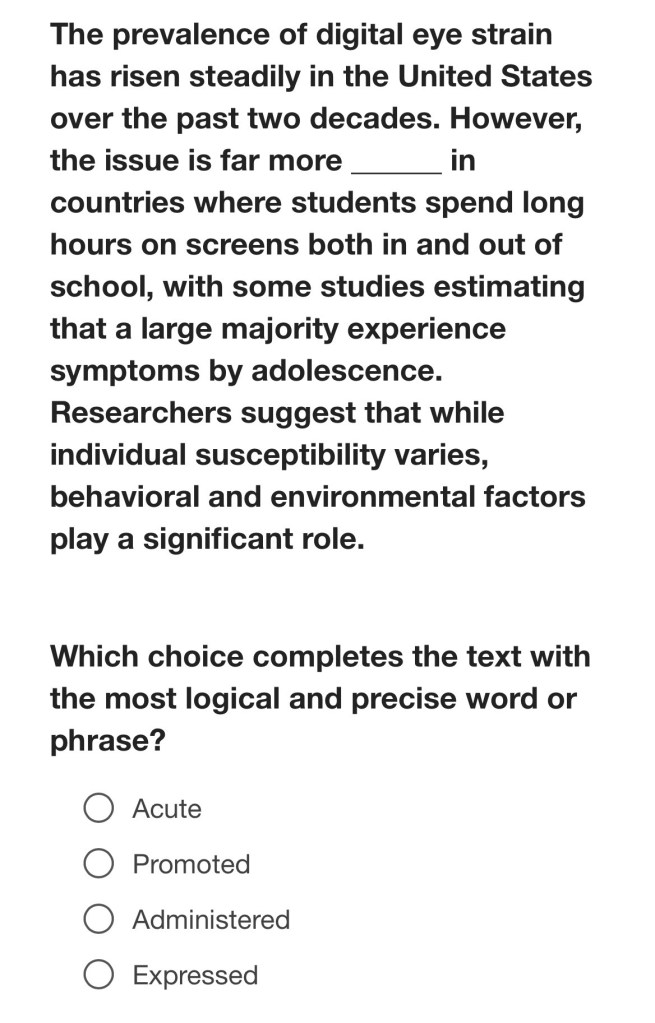
The question asks you to complete a sentence with the most effective word or phrase.
Trap Answer: “…due to the fact that the results were inconclusive in nature.”
Correct Answer: “…because the results were inconclusive.”
Why it is wrong:
The trap answer is wordier, sounds more formal, and has a vaguely academic feel. But “due to the fact that” is a bloated replacement for “because,” and “in nature” adds no actual meaning. Assuming the two answer choices have effectively the same meaning, the SAT rewards the more concise version every time.
How to beat it:
When two answer choices communicate the same idea equally clearly, the SAT typically prefers the more concise version. And “sounds impressive” is never a valid reason to choose an answer.
Free PDF: 8 SAT Trap Answer Red Flags
Deceptively plausible wrong answers follow predictable patterns. This quick-reference cheat sheet breaks down the exact red flags to watch for, so you can recognize trap answers faster and answer with greater precision. (Coming Soon)
The Mental Shift That Changes Everything
Most students approach the two-finalist problem—where they’re stuck between two seemingly good answers—by asking:
“Which of these sounds better?”
Elite scorers ask a completely different question:
“Which of these contains a flaw?”
That shift is everything; instead of choosing the answer that feels most right, you’re eliminating the answer that contains something the passage doesn’t support. One of those two finalists almost always has a tell: an extreme word, a scope that’s too broad, a relationship that’s reversed, or a claim that’s never made.
Your job isn’t to fall in love with the right answer. Your job is to find the flaw in the wrong one.
“Elite scorers do not avoid trap answers because they are smarter. They avoid them because they recognize the SAT’s patterns.”
The Bottom Line
The SAT does not simply reward elite reading comprehension. It also rewards disciplined precision under time constraints.
Every trap answer on this list has one thing in common: it rewards students who verify against the text and punishes students who rely on trusting their instincts. That’s not a flaw in the test, but rather the whole point of the test.
Still getting trapped between two plausible answers?
Most students know what goes wrong. Very few know how to systematically fix it.
Take the free SAT Reading & Writing diagnostic and uncover exactly which trap-answer patterns are costing you points—with instant performance breakdown by question type.
Want a complete system?
The free diagnostic shows where you’re losing points.
My full SAT Reading & Writing course teaches the exact frameworks elite scorers use to stop losing those points.
[Explore the Full Course] (Coming Soon)


Leave a Reply