Lesson Snapshot
Learn the editing framework that transforms SAT Writing from a guessing game into a consistent, evidence-based process.
When students hear the word “parallelism,” many assume it’s a challenging, intimidating concept.
In fact, parallelism is one of the simplest and most useful patterns tested on SAT Writing, and once you learn to see it, you will catch it just about every time it appears.
That consistency is exactly why this concept rewards preparation more directly than almost any other Writing skill on the test and is so worth studying.
What Parallelism Actually Means
Parallelism is as simple as matching one part of a sentence or list to another. When a sentence lists ideas, actions, or qualities, those elements need to share the same grammatical form.
That’s the entire concept. There is no hidden complexity, no exception-riddled rule set to memorize.
The challenge isn’t understanding parallelism conceptually. The challenge is noticing when it breaks, because the SAT is very good at hiding that break in plain sight.
Take this sentence:
The study examined how plants grow, how they respond to light, and the measurement of soil nutrients.
Read at normal speed, this sentence seems fine. There’s no glaring error. This is exactly why so many students miss this type of question.
But the sentence breaks parallel structure, and on the SAT, that counts as an error.
The first two elements, “how plants grow” and “how they respond,” share the same structure. Both begin with “how” followed by a subject and a verb.
However, the third element, “the measurement of soil nutrients,” shifts to something else entirely. It opens with an article and a noun instead.
If multiple items in a list follow one pattern, and a third doesn’t, that mismatch is the error.
Here is the corrected version, with the structure held consistent all the way through:
Notice that fixing the sentence didn’t require adding new information or changing the meaning. It only required rewriting the third element so it matched the grammatical form of the first two. That is the entire fix, every time.
Why This Error Is So Easy to Miss
This is the kind of subtle error that most test takers fly right past, and it’s worth understanding why. Our brains are wired to process meaning, not grammatical form. When you read “the measurement of soil nutrients,” your brain registers that soil nutrients were measured, which is true, and moves on.
Your brain, however, is unlikely to automatically register that the phrase is structured differently than the two items before it. And in most cases, why would it?
Strictly meaning-focused reading is the right approach for nearly all reading you do. But it actually can be a liability on SAT Writing questions that also test structure rather than only meaning.
This is precisely why parallelism questions separate prepared test takers from unprepared ones; once you’re trained to check the structure of a list rather than just its meaning, these questions become fast, reliable points.
You’re no longer relying on a sentence “sounding wrong.” You’re checking a concrete, verifiable pattern, the exact thing SAT Writing rewards.
The Strategy: Identify the Pattern, Then Check Every Element

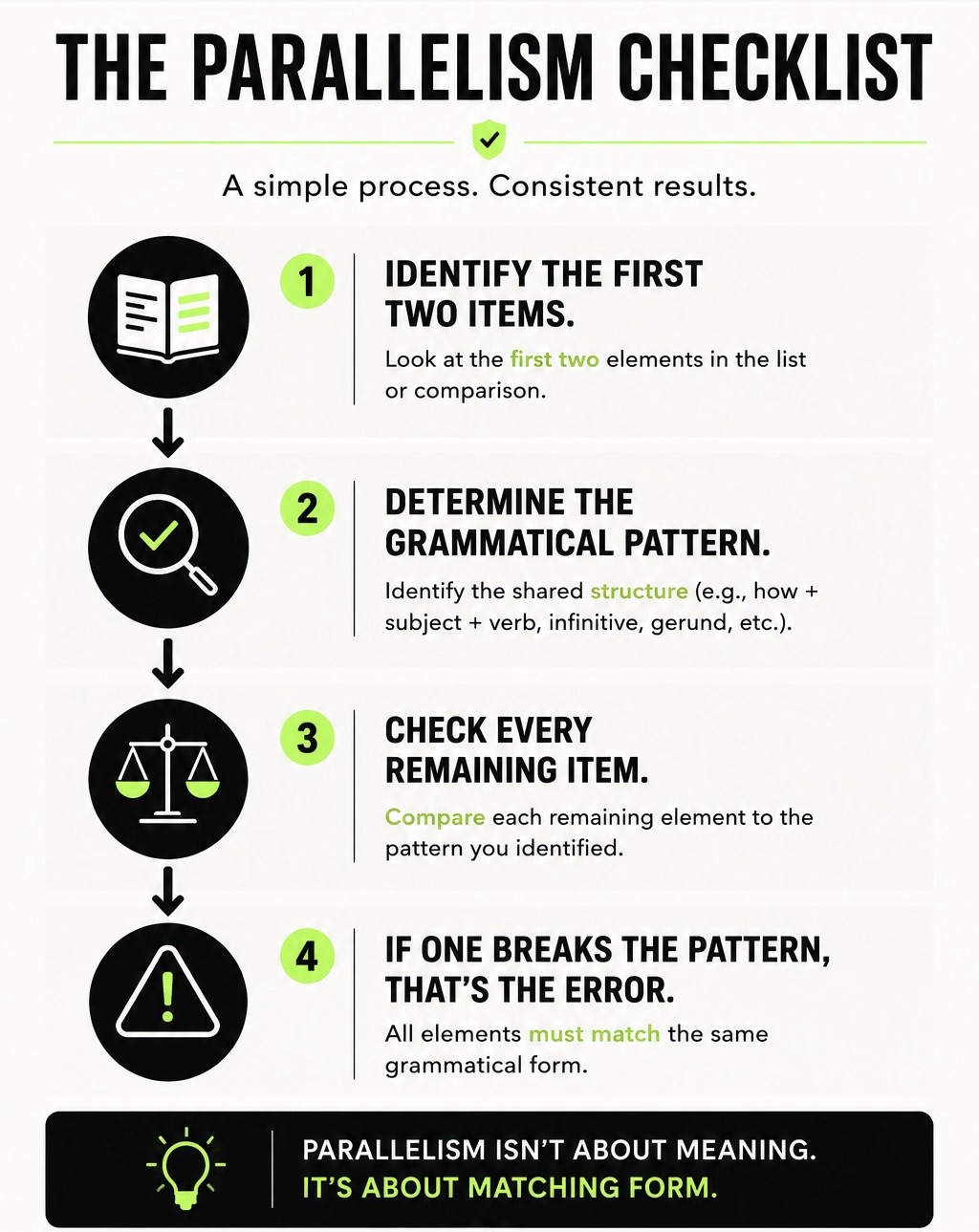
The most reliable approach to a parallelism question is to identify the pattern of the list first, then check whether every element matches it. Look at the first two items. What structure do they share?
Once you know the pattern, check the remaining item or items against it directly. If two items follow the same grammatical structure, the third should almost always follow it as well. This isn’t a coincidence. It is likely the whole basis of the question.
This strategy connects directly to the foundational framework behind everything tested on SAT Writing: the three C’s of Clear, Concise, and Consistent.
Parallel structure is what makes a sentence consistent, and consistency is what makes writing clear and concise. Breaking parallelism isn’t a stylistic nitpick that only bothers English teachers.
It’s a direct violation of the standard the SAT is built to test. Because being both clear and concise is such a central part of the Writing section, a broken parallel structure genuinely matters to your score, even when the sentence otherwise reads smoothly.
Parallelism Isn’t Limited to Lists
It is easy to assume that parallelism only applies to lists of three or more items, but that is not the case.
The SAT also tests whether two clauses within the same sentence follow a matching structure. When ideas are being compared or paired, whether by “and,” “but,” or a similar connector, both sides of that comparison need to mirror each other grammatically.
Look at this example:
The new policy aims to reduce costs and that employee productivity improves.
This sentence breaks parallel structure just as clearly as the list example did, even though there’s no comma-separated list in sight.
The first clause, “to reduce costs,” uses an infinitive, the unconjugated form of the verb. The second clause, “that employee productivity improves,” abandons that structure entirely, introducing a new subject and placing a conjugated verb at the end. The two halves of the sentence are supposed to mirror each other, since both describe what the policy aims to do. Instead, they diverge.
An unprepared test taker skims right past this kind of error, because the sentence still communicates something that makes sense. A 700+ scorer catches it immediately, because they’ve trained themselves to check both sides of any comparison or pairing automatically, the same way they’d check the third item in a list.
The corrected version:
Notice the fix again. Both halves of the sentence now share the same infinitive structure: “to reduce costs and improve employee productivity.” The meaning hasn’t changed at all. Only the structure has been made consistent. (Also note how much more concise the corrected version is.)
Watch for Correlative Conjunctions
The SAT has a favorite disguise for parallelism errors: correlative conjunction pairs like “not only… but also,” “either… or,” and “both… and.”
These phrases signal that two elements are being directly paired, which means the SAT is telling you that a parallelism check is likely coming. Missing that signal is exactly how these questions catch students off guard.
Look at this sentence:
The program is designed not only to improve reading comprehension but also students will develop stronger vocabulary skills.
The phrase “not only” sets up an expectation. Whichever grammatical form follows it needs to reappear after “but also.”
Here, “not only” is followed by “to improve reading comprehension,” an infinitive phrase.
However, “but also” is followed by “students will develop stronger vocabulary skills,” a full clause with its own subject and conjugated verb. The two halves don’t match, even though the sentence reads smoothly enough that most students would never stop to check it.
The corrected version:
This answer is correct because both halves now follow the same structure.
Whenever you spot “not only… but also,” “either… or,” or “both… and” in a sentence, treat it as a direct signal to check the grammatical form on both sides.
Watch for Gerund and Infinitive Mismatches
A related trap involves mixing gerunds–the “-ing” form of a verb acting as a noun (example: running improves one’s health)–with infinitives (the unconjugated “to” form of a verb) within the same list or comparison. These two forms often express similar ideas, which is exactly why the SAT likes to blend them together and see if you notice.
Look at this sentence:
Her favorite hobbies include reading novels, hiking on weekends, and to paint landscapes.
The first two items in this list, “reading novels” and “hiking on weekends,” are both gerund phrases. The third item, “to paint landscapes,” switches to an infinitive. The shift is subtle and often missed because both forms frequently describe an activity, but the SAT treats this as a clear parallelism violation.
Changing “to paint” to “painting” brings the third item back into the same gerund form as the first two.
Building the Habit
The skill you’re building here isn’t memorizing rules about infinitives or gerunds. It’s building the reflex to check structure whenever a sentence presents you with a list or a comparison.
This reflex takes deliberate practice to build, but it pays off faster than almost any other SAT Writing skill, simply because parallelism questions follow the same underlying logic every time.
There’s no ambiguity to wrestle with once you’ve spotted the break, no judgment call about tone or style. Either the structure matches or it doesn’t.
That clarity is what makes parallelism one of the most efficient concepts you can master heading into test day. Learn to spot the pattern, and you’ll turn a question that trips up most students into one of the fastest, most reliable points on the entire section.
Parallelism questions become surprisingly easy once you stop asking, “Does this sound right?” and start asking, “Does every item follow the same grammatical pattern?”
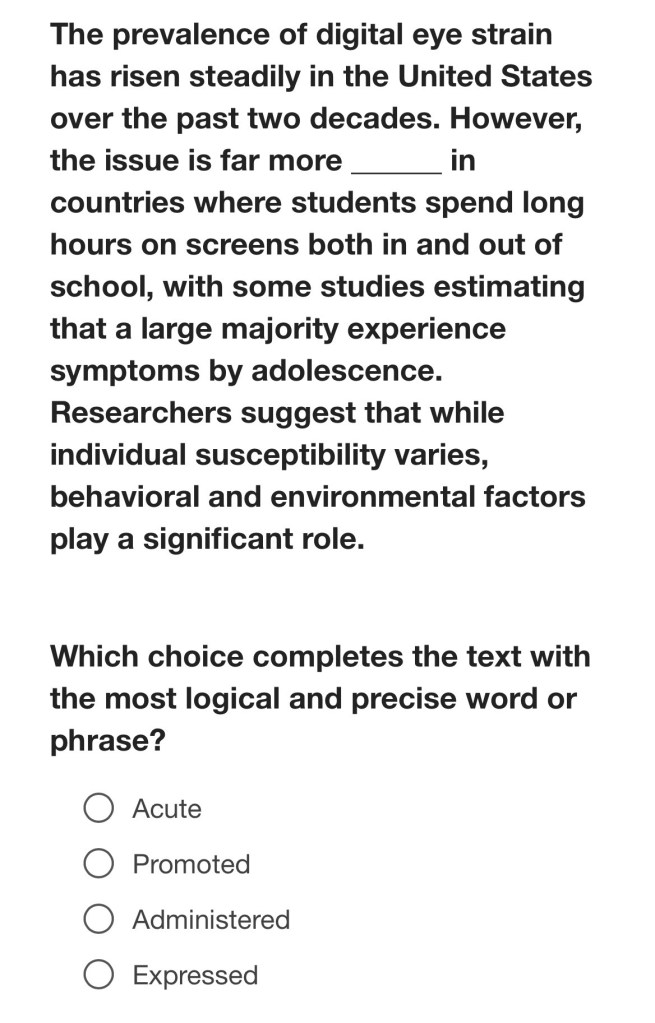
How Parallelism Actually Shows Up on Test Day
Answer Explanation:
(A) being able to collect — Incorrect
Why it’s wrong:
The list begins with planning and coordinating, both simple -ing verbs. Being able to collect changes the grammatical structure by adding an unnecessary phrase instead of matching the other items.
(B) to collect — Incorrect
Why it’s wrong:
The sentence lists three skills using -ing forms: planning, coordinating, and therefore the final item must also be an -ing form. To collect is an infinitive, so it breaks the parallel structure.
(C) collecting — Correct
Why it’s correct:
The sentence lists three skills:
- planning within a limited budget,
- coordinating with local businesses,
- collecting donations from community members.
All three items use the same -ing form, creating correct parallel structure.
(D) the process of collecting — Incorrect
Why it’s wrong:
This answer changes the pattern from a single -ing verb to a longer noun phrase (the process of collecting). Although it makes logical sense, it does not match the grammatical form of planning and coordinating.
Strategy Reminder:
SAT Parallelism Tip:
When you see a list, compare the grammar—not the meaning. If the first two items are planning and coordinating, the third should simply be collecting. Matching structure is often enough to find the correct answer.
If your goal is to push your SAT Reading and Writing score into the 700+ range, read The Ultimate Guide to Scoring 700+ on SAT Reading and Writing. It shows how sentence boundaries fit into the broader set of skills and strategies that high scorers use consistently.
Not sure whether boundaries are actually one of your biggest weaknesses? Take my Free SAT Reading & Writing Diagnostic Exam. It breaks your performance down by question type so you can see exactly where you’re losing points—and what to study next.
Frequently Asked Questions
What is parallelism on the SAT?
Parallelism means that words or phrases serving the same function should use the same grammatical structure.
Correct: She enjoys reading, writing, and painting.
Incorrect: She enjoys reading, to write, and painting.
How do I spot a parallelism question?
Look for lists, comparisons, and paired constructions such as both…and or not only…but also.
Do the words have to be identical?
No. The structure must match, not the exact wording.
What’s the fastest way to solve these questions?
Strip the sentence down to the repeated elements and compare their forms.
to research / to analyze / to present
If the pattern matches, it’s parallel.
Should I rely on what sounds right?
No. Long sentences can hide parallelism errors. Check the structure instead of trusting your ear.


Leave a Reply