The way you have been trained to read for school is not the way you should read on the SAT.
That is not a criticism of your English teachers, nor does it negate all of the reading you have done that has made you a successful student. It is just that reading for your classes and reading for the SAT are two different approaches. One–reading for classes–rewards depth, interpretation, and complete understanding. Meanwhile, reading for the SAT rewards a strictly evidence-based and highly efficient approach. As a result, many of the reading habits that earn A’s in English class do not translate to the SAT, and students often unknowingly cost themselves points by not adjusting their reading approach on test day.
Let me walk through how these kinds of reading differ, and how to shift into the mode the SAT actually rewards.
How Reading for School Differs From SAT Reading
Think about what reading looks like in a high school English class. You might spend two weeks on a single novel. You annotate the margins, track motifs, debate a character’s motives, and write essays arguing about authorial intent and symbolism. A good literature class treats a text as something to be explored, and the deeper you go, the better.
That kind of reading is analytical and time consuming by design. It is also, especially in literature, comfortable with ambiguity. A poem can mean two things at once. A narrator can be unreliable. An ending can be deliberately unresolved. Teachers often reward the student who sees a layer others missed, so high achievers learn that a creative, well-argued interpretation is a sign of sophistication.
In a literature class, students often have the time and opportunity to explore a text’s complexities in considerable depth. They can revisit difficult passages, consider competing interpretations, and develop arguments over several days.
None of this is bad. These are highly valuable skills. They are just built for a different purpose than SAT Reading and Writing, which imposes a totally different challenge: students must identify the answer best supported by the evidence within a tightly controlled timeframe.
Why Some Good Readers Struggle With SAT Reading and Writing
Unlike open-ended literary analysis, SAT Reading and Writing questions are designed to have one defensible answer. That answer must be supported by the passage, whether through information stated explicitly or a conclusion that logically, implicitly follows from it. The SAT does not reward interpretations simply because they are plausible. It rewards conclusions that the evidence actually justifies.
This is not a random choice from the test makers. Millions of students take the SAT, and colleges compare those scores across schools, states, and countries. For those scores to be reliably comparable, each question needs a clear best answer that can be justified by the text. For more about why every correct answer on SAT Reading and Writing can be proven, read here.
If a question allowed two defensible interpretations, it would make scoring less consistent and start measuring how closely a student’s thinking happened to match the question writer’s, not students’ reading comprehension ability.
So, in effect, the core question changes. In English class, you ask, “What could this mean?” On the SAT, you ask, “What conclusion does the evidence actually justify?”
If you need phrases like “maybe” or “this could symbolize” to defend an answer, you are interpreting, not proving. Eliminate it.
Worked Example: The A+ Essay Answer vs. the Provable Answer
Worked Example: The A+ Essay Answer vs. the Provable Answer
Here is a literature question in the style of the digital SAT. Read it the way your English teacher would, and then read it the way the SAT requires.
Every morning for thirty years, Margaret had walked to the end of the pier before opening the shop. On the day the shop passed to its new owners, she walked to the end of the pier as usual, stood there a moment longer than she ever had, and then turned back toward town without looking at the water again.
Based on the text, what can most reasonably be inferred about Margaret?
A. She regrets selling the shop and wishes she could reverse her decision.
B. She departs slightly from her morning routine on the day the shop changes hands.
C. She has grown weary of the sea after thirty years of living beside it.
D. She intends to leave town now that the shop belongs to someone else.
The pier, the water, and Margaret’s refusal to look back all invite interpretation. A student could construct several compelling explanations for her behavior, particularly about how she feels as she leaves the shop behind. But, again, only what can be directly supported by the text can be correct.
Choice A is the answer that likely would especially appeal to a strong literature student because it is the most emotionally rich reading. But, as reasonable and seemingly defensible as this answer is, the passage never mentions regret, and it never suggests she wants to undo anything. “Regrets” and “reverse her decision” are interpretations layered on top of the text, not from the text.
Choice C treats “without looking at the water again” as a symbol of weariness. That is a reasonable literary reading, and in class it might even earn credit. On the SAT, it is unsupported. Nothing in the passage tells you how she feels about the sea.
Choice D is tempting because she “turned back toward town,” but turning toward town is not actual evidence of leaving it. There is no mention of any plan, so we really have no idea. Not provable.
Choice B is the only answer you can prove. She followed the same routine for thirty years, and on this day she “stood there a moment longer than she ever had.” That one detail is direct evidence that the day was different for her. B is less interesting than A, and that is exactly the point. The SAT does not reward the most insightful answer. It rewards the best-supported answer, and seeking the best-supported answer is a crucial part of avoiding trap answers.
Just because an answer choice is the most interesting one does not mean it is right. Trap answers for literature questions are frequently written to sound sophisticated and plausible, yet unsupported interpretations.
3 Reasons Strong Students Get SAT Questions Wrong
This disconnect between reading approaches is a significant part of why I see so many high achievers stuck in the 600s. They are not weak readers. They are excellent readers, just using the wrong reading mode.
Three specific habits pop up the most often. The first is open-ended interpretation, which you just saw: relying on subjective, plausible interpretation instead of textual evidence.
The second is choosing what “sounds right.” School essays reward fluent, elegant phrasing, so students learn to trust answers that sound polished and sophisticated. The SAT writes plenty of polished, sophisticated wrong answers, but that does not automatically make them right.
The third is outside knowledge. Students who read widely know a lot, and they bring that knowledge to the passage. But if your reason for choosing an answer comes from something you learned outside the text, it does not count, no matter how true it may be.
All three of these bad habits share the same root: they answer a question other than “Where is the evidence for this in the passage?”
Elite scorers do not stop using the reading comprehension and analytical skills they have developed in school. They just redirect them. Instead of using their reading skill to generate subjective interpretations, they use those skills to test each answer choice against the exact words in the passage.
Do You Need to Understand Every Word of a Passage?
Here is another major difference, and it surprises students even more than the first: on the SAT, you should not try to understand every passage completely.
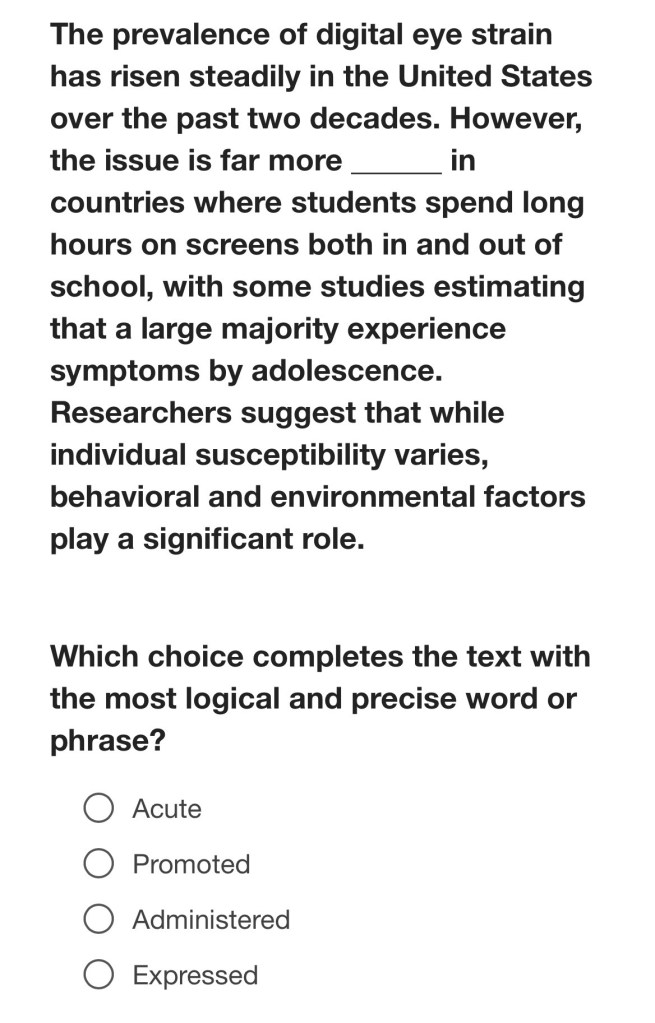
The Reading and Writing section gives you 64 minutes for 54 questions, which works out to a little over a minute per question. That minute has to cover reading the passage, reading the question, evaluating four choices, and confirming your answer. The close-reading approach that you use for schoolwork–which depends on having hours to read and analyze–simply does not fit.
The good news is that you do not need it. Each digital SAT Reading and Writing question is built around one short passage and one specific task. You do not need to account for every word choice to identify a passage’s main purpose or to choose the finding that best supports a claim. You only need to understand the passage well enough to answer the question in front of you.
That is to say, you do not need to understand every detail and nuance of a passage, but instead, you need to understand its central ideas, logical structure, and the details relevant to the question. Do not stop to untangle every nuance or detail except for the ones that the question specifically depends on.
The goal is not to understand the passage completely. The goal is to understand it well enough to prove one answer.
Efficient, Not Fast: How to Stop Overthinking SAT Reading Questions
Some students hear “don’t aim for 100%,” and look at the relatively short amount of time per question, and conclude they should rush. That is the wrong lesson. Speed for its own sake produces careless misreads, and a careless misread is just another way of answering without evidence.
The goal is efficiency. Efficient reading means every second has a purpose. Read the question first so you know what kind of evidence you are looking for. Read the passage once with that purpose in mind, slowing down on the parts the question points you toward and moving steadily through the rest. Form a quick prediction of what the answer must say. Then check each choice against that prediction. Read more about why elite scorers often make predictions here.
What efficient reading eliminates is wasted time like having to reread the entire passage because you started without a purpose, debating two choices on gut feeling instead of evidence, or analyzing a detail the question never asked about. A student reading efficiently often looks calm rather than fast, because they are not doing anything unnecessary.
The same principle applies to Writing questions. You do not need to appreciate the elegance of a sentence about the history of glassmaking. You need to see its structure clearly enough to choose the punctuation it requires, or understand the logical relationship between two sentences well enough to choose the right transition.
The best SAT readers are not the fastest readers in the room. They are the ones who know exactly what they are reading for before they start.
Find Out Which Habits Are Costing You Points
Knowing that your reading habits might be costing you points is the first step. The next is identifying where those habits affect your performance. My free SAT Reading and Writing diagnostic helps you identify your strongest and weakest question types, so you can stop practicing blindly and start targeting the skills that matter.
The Bottom Line
School reading asks you to go deep, explore ambiguity, and understand everything. The SAT asks for something very different: objective, evidence-based reading done efficiently within time constraints.
That difference is not a flaw in the test. It is the design. Once you stop treating SAT passages as texts to interpret and start treating them as evidence to verify, the questions get clearer and your score starts to move.
Read deeply in class. Read for proof on test day.
FAQ
Why am I good at English but bad at SAT Reading?
Strong classroom reading skills don’t always translate directly into SAT performance. English classes often reward extended interpretation and exploration, while SAT Reading questions require precise answers supported by the passage. Students who rely too heavily on interpretation can choose plausible but unsupported answers.
Why do I understand SAT passages but still get questions wrong?
Understanding a passage’s general meaning isn’t always enough. You must identify exactly what a question asks and verify that every claim in your answer is justified by the relevant evidence.
How do I stop overthinking SAT Reading questions?
Start by identifying the task, locating the relevant evidence, and predicting what the correct answer should communicate. Eliminate answers that require unsupported assumptions, even if they sound sophisticated or plausible.
Do I need to understand every word in an SAT Reading passage?
No, don’t waste time analyzing every detail in a passage, only the ones directly relevant to the question. Prioritize understanding the passage’s central idea and/or claim, logical structure, and relevant details.


Leave a Reply