Imagine a student sitting down with a single SAT Reading and Writing question set. They read the excerpt carefully, eliminate appealing but incorrect answers, and land on the correct answer with confidence.
Give them a handful of questions like this, and they look every bit like a student capable of an elite score.
Now, put the actual SAT in front of that same student and it’s a totally different scenario. Sure, ten questions in, they still feel sharp. Fifteen in, however, their focus begins to waver.
By question twenty, they realize they just read an entire excerpt and retained almost nothing, having to read it over again while the clock keeps moving. A few questions later, mental fatigue sets in even harder.
Instead of carefully weighing answer choices, they begin relying on instinct.
A subtle wording difference they would have caught earlier slips past them. An answer that merely sounds right gets chosen because they are fatigued and want to move on.
By the end of the section, the issue is not that the student lacked the reading ability to succeed. Instead, it is that their attention drifted in and out just enough for preventable mistakes to pile up, quietly pulling what could have been an elite score back down into the merely “good” range.
The issue isn’t reading comprehension. It’s the ability to stay focused on reading high-level writing excerpts for an extended period.
For many students, the challenge is less about improving reading comprehension and more about developing SAT reading focus, SAT attention span, and overall SAT test endurance.
In fact, many students who ask “Why do I do well on individual passages but poorly on full SAT tests?” are describing a stamina problem, not a comprehension problem.
They have the ability to answer difficult questions correctly, but they struggle to maintain that level of performance throughout an entire exam.
Reading stamina is the thing that creates the gap between what a student is capable of on a single excerpt and what they actually produce across a full module.
This is the most underdiagnosed performance gap in SAT prep, and the one most tutors never think to address. If you’re a strong student (or the parent of one) whose SAT Reading and Writing score doesn’t reflect what you’re capable of, keep reading.
The Gap No One Talks About
Simply put, the gap between a student’s reading comprehension ability and their reading stamina is often the single largest driver of underperformance on SAT Reading and Writing.
This is especially true for students who wonder why their SAT Reading score drops on full-length SAT practice tests compared to shorter practice exercises.
The issue is not that they somehow forget content or strategy. Rather, their focus and accuracy gradually deteriorates as the test progresses.
What does that look like in practice?
Students who have the ability to produce sharp analysis and identify correct answers based on a timely, full comprehension of a single passage don’t suddenly lose the ability to do those things on test day.
No, it’s generally not because the passages got harder, either. The real culprit is that they simply are not conditioned to sustain the level of sustained focus that the SAT demands.
The SAT doesn’t just force you to effectively comprehend high-level academic writing; it asks you to do so for an extended period of time, a skill very few students ever think to develop.
Why Do I Lose Focus During SAT Reading and Writing?
Students often push back when I raise the issue of reading stamina or what many describe as SAT concentration problems.
“I read all the time,” they say. “I do hours of homework every night.”
True, but almost never under the conditions the SAT imposes.
Think about how most students actually read for school: a few paragraphs, then a text notification. A page or two, then Instagram. Even in class, there are natural pauses and moments to breathe, or a classmate to chat with.
Common Misconception: “I Read for School Every Day, So I Have Plenty of Reading Stamina.”
Reading in fragmented, low-stakes bursts is fundamentally different from the sustained, high-focus reading the SAT requires. Developing SAT test endurance requires training your attention span to last for much longer periods than most students ever practice.
Classwork is a series of short sprints.
The other, on test day, is a distance race, and you can’t train for a mile by jogging thirty seconds at a time.
Here’s the unavoidable question:
Could you read right now, fully focused, no phone, no daydreaming, no drifting, for 15 consecutive minutes? 30? How about 45?
Honestly?
Most high school students (and plenty of adults) would struggle.
This isn’t a character flaw. It’s a skill deficit, and skill deficits can be fixed with a good, sustained plan.
What SAT Reading Mental Fatigue and Concentration Problems Actually Look Like
Mental fatigue rarely announces itself as “I have no idea what I just read.”
More often, it’s subtle. Sneaky. And damaging to your score.
Students experiencing SAT Reading mental fatigue often describe feeling sharp at the beginning of a section but noticeably slower by the end.
Their comprehension becomes less precise, their attention wanders more frequently, and they become increasingly vulnerable to trap answers and careless mistakes.
Why Mental Fatigue Makes Trap Answers More Dangerous
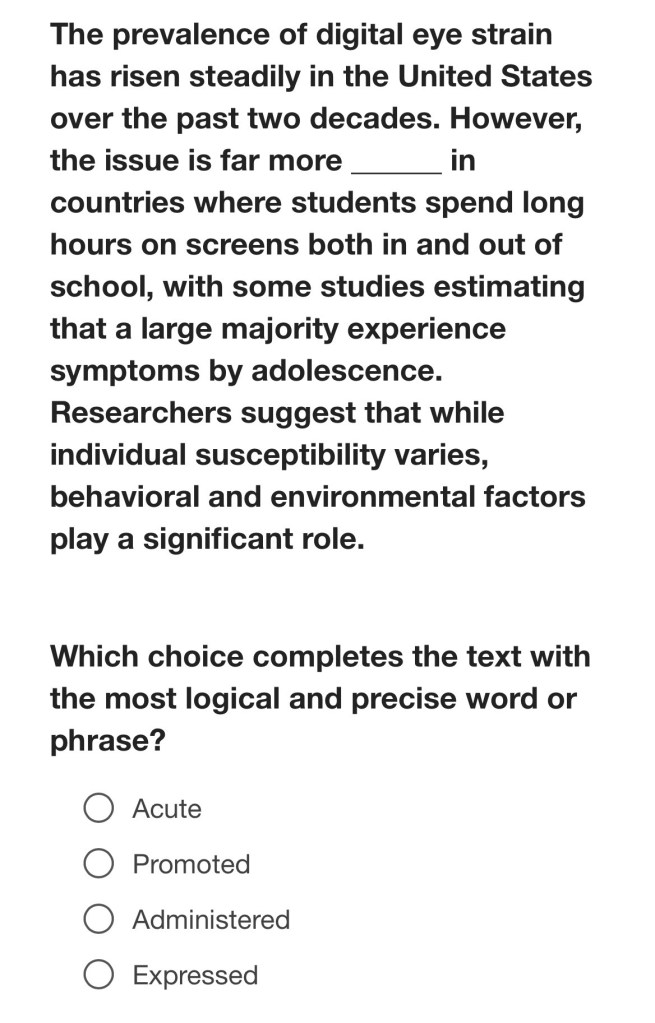
Reading stamina matters because fatigue changes how students evaluate answer choices.
Early in the section, a strong student carefully compares plausible answers and verifies their choice against the passage. Later, as attention fades and mental exhaustion sets in, that same student becomes more likely to rely on instinct.
That is exactly when trap answers become most effective.
Rarely are SAT trap answers obviously wrong. Instead, they are designed to be highly plausible, making them especially tempting to students whose focus is beginning to fade.
As mental fatigue increases, students apply less scrutiny to answer choices and become more vulnerable to these traps.
This is one reason many students miss more questions near the end of a module than at the beginning.
Want to see what these traps actually look like? Read How to Avoid SAT Trap Answers: 8 Patterns Every Student Should Know.
The Warning Signs
- You read a sentence, then realize you retained nothing.
- Your eyes track the words but your brain is two paragraphs behind.
- You feel mentally “flat” halfway through the section.
- You make careless mistakes on questions that feel obvious in hindsight.
- Your accuracy drops as the SAT goes on.
- You perform significantly better on short practice sets than on full-length SAT practice tests.
- You feel yourself losing focus halfway through the SAT.
- You miss questions late in the section that would have felt easy twenty minutes earlier.
If several of these warning signs feel familiar, there is a good chance that reading stamina—not comprehension—is the underlying issue.
Example: The Drift
A student reading a passage about 19th-century social reform starts strong—processing the argument, noting the tone.
Around paragraph three, her mind quietly drifts:
Do I have practice tonight?
She snaps back.
But she’s missed three key sentences.
The question that follows asks about the author’s contrast between two reformers, exactly the detail she drifted through.
She guesses.
She’s wrong.
This is why careless mistakes on SAT Reading are so often not careless at all.
They’re stamina mistakes wearing the costume of carelessness. And they can add up quickly for fatigued students, and most never realize why.
The Distance Runner Analogy
Consider a distance runner who is highly skilled: long stride, strong lungs, excellent running form.
But suppose she only ever trained in 100-meter bursts.
Would she expect to compete at an elite level in a half-marathon?
Of course not.
The event requires conditioning that only comes from specific practice.
The SAT Reading section is the same thing.
Even the very strongest readers are setting themselves up for failure if they have not trained for reading academic writing for extended periods. Most students have been training like sprinters.
Without Stamina
A student reads in short bursts. Fatigue by the halfway point results in mental drift, leading to numerous missed details and subsequent careless errors.
This student misses several questions they absolutely would have gotten right if it had been the only one they had to answer.
They do not come close to fulfilling their score potential.
Typical Score Range: 600–670
With Built Stamina
A student sustains focus, stays locked in passage-to-passage, and maintains their edge through the end of the section.
Typical Score Range: 720–760+
Same comprehension.
Same vocabulary.
Same strategy.
The difference is conditioning. Better SAT reading focus and stronger SAT test endurance allow students to sustain their highest level of performance throughout the section.
How to Build Reading Stamina for the Digital SAT
Step 1: Read Daily—But the Right Material
Fifteen to thirty minutes a day is enough, but only with the right material.
Students often ask how much they should read each day for the SAT. The answer is less about volume and more about consistency.
Even 15–30 minutes of focused daily reading can dramatically improve reading endurance for the SAT over time.
You need to train against SAT-level resistance:
- Academic journals (social science, psychology, economics, history)
- Long-form science writing (The Atlantic, Quanta Magazine, Scientific American)
- Historical and political essays (The Federalist Papers, primary sources)
- Dense, syntactically complex literary prose—the kind the SAT loves
Key Insight: The goal isn’t just to read more. It’s to build your brain’s ability to stay attentive while processing demanding, unfamiliar material.
Easy reading builds leisure habits, not test endurance.
Not sure which materials to start with? Don’t worry: click here to learn more about The Verbal Method’s Reading Stamina Builder (coming soon)
Step 2: Eliminate Distractions Completely
Phone in another room.
No music (especially with lyrics).
No notifications.
You are conditioning your brain to sustain focus without the dopamine hit of a quick scroll.
Every session where you resist that urge is a rep in the gym.
Start with 15 uninterrupted minutes.
Then 20.
Then 30.
Then 45.
If your goal is to improve concentration during SAT Reading and strengthen SAT reading focus, uninterrupted reading sessions are non-negotiable.
Focus is not merely something you possess.
It is something you train. And it must be trained in the same conditions of test day: silence, complete concentration, no distractions or stimulation, and sustained focus.
Step 3: Read Actively
Passive reading builds little test stamina.
Read actively:
- Summarize each paragraph in one sentence before moving on.
- Notice shifts in tone, argument, or perspective.
- Ask: What is the author claiming? What’s their evidence? Is there a counterargument?
Another key element of reading actively is not choosing answers because they sound right, but choosing answers that you can prove with evidence directly from the text of each passage. For a deeper look at this principle, read If You Can’t Prove It, You’re Guessing: Why Strong Students Still Miss SAT Reading Questions.
Step 4: Simulate Test Conditions
Read one dense excerpt after another with no breaks between them.
History, then science, then literary, then social science.
The SAT doesn’t give you a break between passages.
Your practice shouldn’t either.
And again, no phone, no distractions, no stimuli (including music).
Sample 30-Minute Session
Minutes 1–8: Dense historical essay (e.g., Tocqueville’s Democracy in America). Summarize mentally.
Minutes 9–16: Social science article on behavioral economics. No break.
Minutes 17–24: Nineteenth-century scientific text. Note the complex syntax.
Minutes 25–30: Reflect. How much did you actually retain?
In-the-Moment Focus Strategies
Anchor at the Start of Each Passage
Before reading a word of body text, check the blurb, publication year, and source.
Two seconds.
It primes your brain for what’s coming instead of crashing into dense prose cold.
When You Drift, Don’t Panic
Go back one sentence—not three paragraphs.
Find your footing and move on.
Panic and a full re-read waste far more time than the drift itself.
It is totally fine to close your eyes and take a few deep breaths to reset. Better that than reading the same paragraph over and over!
How Long Does It Take?
Two to four months of consistent daily practice produces dramatic, measurable improvement—assuming 15–30 minutes a day of active, distraction-free reading in challenging material.
Students who commit to this consistently report that the test feels different. Their SAT attention span improves, their focus becomes more consistent, and difficult passages feel less mentally taxing.
Passages that felt overwhelming six weeks earlier now feel manageable.
That level of mental endurance is one of the most valuable advantages you can walk into the testing room with.
Attention Span Is Trainable
Students frequently ask whether attention span for SAT Reading can be improved.
The answer is unequivocally yes.
Attention, concentration, and reading endurance all respond to deliberate practice in the same way athletic conditioning does.
The students scoring 700+ on SAT Reading generally are not particularly smarter or luckier than those who score in the 600’s.
Many of them have simply trained the specific skillset this section demands.
You don’t need to be a natural reader. You need to be a trained reader.
Quick Self-Assessment
- Do you perform better on short practice sets than on full sections?
- Do you feel mentally flat, mentally tired, or noticeably less focused by the end of the Reading section?
- Do your answers get less accurate on later passages?
- Are your “careless” mistakes clustered toward the end?
If you said yes to even two of these, stamina is a significant factor in your score, and it’s one of the most trainable, most directly impactful things you can improve before test day.
You already have the intelligence.
You already have the comprehension.
Now it’s time to build the endurance to unleash it.
The Reading Stamina Builder — From The Verbal Method
The Reading Stamina Builder is a curated collection of short, high-difficulty excerpts—academic journals, historical texts, scientific writing, and complex literary prose—designed to simulate the exact experience of reading one unrelated passage after another, just as the SAT delivers them.
- 10+ genres and disciplines—nothing ever feels familiar
- Difficulty calibrated to real SAT passage complexity
- Timed, back-to-back sessions that build endurance progressively
- Comprehension checkpoints after each excerpt
- A 4-week protocol designed to close the stamina gap before test day
This isn’t another practice test.
It’s the training that makes practice tests actually mean something.
→ Explore the Reading Stamina Builder at verbalmethod.com
Not sure whether reading stamina is the only thing holding back your score? Take The Verbal Method’s free SAT Reading & Writing Diagnostic to identify the specific skills costing you points and build a targeted improvement plan.
→ Take the Free Diagnostic
Still have questions about reading stamina? Here are answers to some of the most common questions students and parents ask about reading stamina and SAT performance.
Frequently Asked Questions
Can reading stamina improve SAT scores?
Yes. Many students already possess the comprehension skills necessary to answer difficult SAT Reading and Writing questions correctly, but struggle to maintain that level of performance throughout an entire section. Improving reading stamina helps students sustain focus, reduce mental fatigue, and avoid the preventable mistakes that often separate good scores from elite ones.
How long does it take to improve reading stamina for the SAT?
Most students see meaningful improvement within two to four months of consistent practice. Reading for 15–30 minutes per day, using challenging material and minimizing distractions, can significantly improve focus, endurance, and overall test performance over time.
Why do I score lower on full-length SAT practice tests?
Many students perform well on individual passages but struggle on full-length SAT practice tests because of mental fatigue. This is one of the most common signs of a reading stamina problem. As the test progresses, focus and accuracy often decline, making students more vulnerable to trap answers, missed details, and careless mistakes. In many cases, the issue is not comprehension but stamina.
How much should I read each day for the SAT?
For most students, 15–30 minutes of focused daily reading is sufficient. The key is consistency and difficulty. Academic journals, long-form science writing, historical essays, and complex literary prose are all excellent choices because they develop the kind of sustained attention the SAT requires.
Can attention span be improved?
Absolutely. Attention span is not a fixed trait; it is a trainable skill. Just as athletes build physical endurance through deliberate practice, students can improve concentration, focus, and reading endurance through regular exposure to challenging material under distraction-free conditions.Looking to improve your SAT Reading and Writing score, but don’t know where to start? Start with The Ultimate Guide to Scoring 700+ on SAT Reading and Writing.


Leave a Reply