You earned A’s in AP English. Your teachers praise your analytical writing.
You’ve dissected The Great Gatsby, written polished essays on unreliable narrators, and worked through reading lists that would intimidate most adults.
Then your SAT Reading and Writing score comes back in the 600s. Maybe even lower.
Your parents are baffled. You are baffled. Frankly, anyone who has not worked specifically with high-achieving SAT students is probably baffled.
But I’m not; I have seen this exact profile dozens of times.
And the reasons behind it are remarkably consistent. Better yet: they’re fixable.
If you’re a strong student stuck below your target SAT verbal score, the issue is probably not intelligence, work ethic, or academic ability.
It’s strategy.
Let me explain what’s actually going on.
Why Being “Good at English” Doesn’t Automatically Guarantee an Elite Score on SAT Reading and Writing
The SAT Reading and Writing section is not a general test of academic sophistication.
It is a specific, timed, rules-based assessment with its own logic.
Confusing those two things is one of the biggest mistakes high-achieving students make.
You might genuinely love literature. You might write beautiful essays. You might devour history books and excel at analyzing primary sources.
None of that automatically translates to a 750+ SAT Reading and Writing score.
Here’s why.
Reason 1: AP Classes Trained You to Read the Wrong Way for the SAT
This sounds counterintuitive, but it is one of the most common patterns I see.
The very habits that helped you earn 4s and 5s on AP exams may be actively working against you on test day.
AP Reading Rewards Interpretation
AP English often trains students in close reading: slow, deliberate engagement with a text in pursuit of deeper meaning.
Students are taught to ask:
- What does this passage really mean?
- What metaphorical significance does this detail carry?
- What subtext is hiding beneath the surface?
- What is the author implying?
This is a sophisticated academic skill.
It is also often the wrong instinct for the SAT.
SAT Reading Rewards Verification
The SAT is not asking what a passage could mean if interpreted creatively. It is asking what the passage actually supports. That distinction is crucial.
Yes, the SAT includes inference questions. But even those inferences must be tightly constrained by textual evidence. This is a far cry from the more ambiguous, open-ended interpretive work rewarded in literature classrooms.
For example:
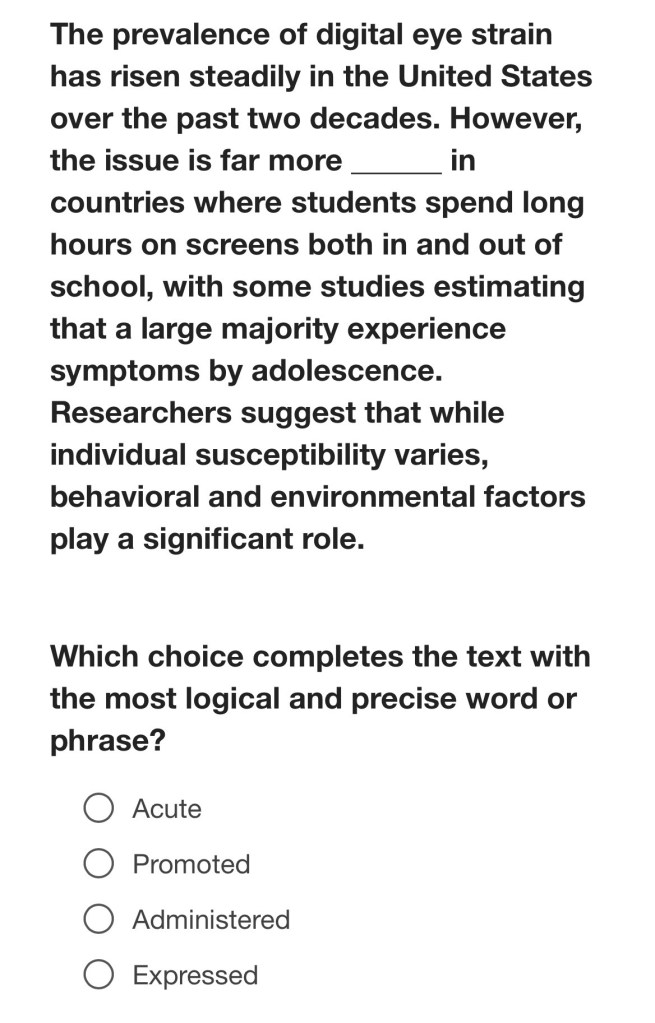
A word in context question is not asking you to unpack symbolic meaning or thematic resonance.
It is asking:
What does this word mean here, in this exact sentence, based on the surrounding context?
That is a fundamentally different task.
Why Strong Students Fall Into This Trap
For academically gifted students, this mismatch is genuinely counterintuitive.
When they see figurative language, they instinctively analyze. When a passage appears straightforward, they instinctively look for hidden complexity. When an answer sounds sophisticated, nuanced, or intellectually interesting, they gravitate toward it.
These are fantastic instincts in seminar-style classrooms. On the SAT, they often lead directly into trap answers.
SAT Reading and Writing questions do not reward the most interesting or intellectual interpretation. It rewards the most defensible one.
The Core Mindset Shift
Elite scorers stop asking
“which answer sounds right?”
and start asking:
“which answer can I prove?”
How to Fix It
The good news? This problem is highly fixable.
Students who make major SAT Reading and Writing score jumps usually do not become dramatically better readers or test takers overnight.
They simply learn to apply a different framework.
Here’s what that looks like:
1. Shift from Interpretation to Evidence
The single most important adjustment that strong students must make is moving from interpretive reading to evidence-based reading.
In advanced English and history classrooms, students are often rewarded for uncovering ambiguity, symbolism, and deeper thematic meaning.
The SAT asks for something much narrower:
What does the text actually support?
That means replacing questions like:
- What is the author really trying to say?
- Could this symbolize something deeper?
With questions like:
- Where is the evidence for this?
- What can I actually prove from the passage?
This mindset shift alone can dramatically improve accuracy.
2. Think Like a Detective, Not a Literary Critic
SAT Reading rewards disciplined evidence gathering, not elegant interpretation.
Every correct answer should be defensible with clear textual support.
If you cannot point to the sentence, phrase, or specific detail that justifies your answer, you are probably relying on intuition.
In other words:
You are guessing.
The strongest scorers approach each passage like a case to solve.
They gather evidence. They eliminate unsupported claims.
They refuse to “convict” an answer choice without proof.
That is the mindset the SAT rewards.
3. Stop Overcomplicating Straightforward Passages
High-achieving students often assume obvious answers must be traps.
That instinct makes sense in academic environments, where deeper analysis is often rewarded.
But on the SAT, the opposite is frequently true; the test is not usually hiding a secret interpretation beneath the surface.
If a passage clearly supports an answer, that answer is often correct, even if it feels almost too straightforward.
Many strong students lose points not because they miss subtle meaning, but because they invent complexity that was never there.
Do not make the passage harder than it actually is.
4. Learn What the SAT Actually Rewards
Many high-achieving students get stuck between two answer choices that both sound intelligent.
This usually happens because they are evaluating answers using classroom instincts instead of SAT logic.
A correct SAT answer is not merely thoughtful, nuanced, or arguable.
It must be:
1. Directly supported by the text
2. Precise
3. Fully correct
4. Free of exaggeration
5. Directly relevant to what the question is actually asking
This is where trap answers do their damage.
Many wrong answers are designed to sound polished, sophisticated, and almost correct.
But “almost correct” is still wrong.
The SAT does not reward sophistication for its own sake.
It rewards precision.
5. Read Efficiently, Not Exhaustively
Close reading is intentionally slow.
The SAT is not.
One of the biggest mistakes strong students make is assuming they need to fully unpack every nuance of a passage before answering confidently.
You do not.
The SAT does not reward exhaustive literary analysis. It rewards efficient comprehension under time pressure.
That means focusing on what actually matters:
- the main idea
- the author’s purpose
- tone
- relationships between ideas
- relevant textual evidence
Elite scorers understand an important truth: complete comprehension is not the goal.
In most cases, a strong “big picture” understanding—roughly 80% comprehension—is more than sufficient, provided you can accurately locate and use evidence when needed.
Students chasing perfect understanding often read too slowly, overanalyze straightforward passages, and burn valuable time trying to decode details that never end up mattering.
Strong SAT readers read strategically.
They identify what matters.
They extract the relevant information.
Then they move on.
The Big Takeaway
Strong students often struggle on the SAT not because they are weak readers, but because they are applying the wrong reading framework.
Once you replace interpretation with verification, intuition with evidence, and overthinking with disciplined process, elite scores become much more attainable.
Reason 2: They’re Trusting Intuition the SAT Was Designed to Fool
Strong readers trust their instincts.
And in most academic settings, that trust is well earned.
Years of reading, discussion, essay writing, and classroom analysis build genuine academic intuition. Strong students develop an excellent feel for tone, argument, authorial intent, and plausible interpretation.
In academically rigorous classrooms—especially AP English, history, humanities seminars, and discussion-based courses—confidently offering an interpretation is often seen as a sign of intellectual sophistication.
Students are rewarded for:
- trusting their instincts
- engaging complex material confidently
- offering plausible interpretations quickly
- defending nuanced readings
In those environments, that confidence is often an asset.
On the SAT, however, it can become a liability.
The SAT does not reward confidence.
It does not reward intuition.
And it certainly does not reward interpretations that merely seem plausible.
It rewards one thing:
Answers that can be directly supported by the text.
That distinction creates a major problem for many strong students.
Because they are accustomed to being right in academic settings, they often trust what they think a passage means instead of verifying what the passage actually says.
And that is exactly where the SAT punishes them.
What This Looks Like in Practice
A strong student reads a passage. They form a confident impression of what the author seems to be saying. They move to the answer choices.
One answer immediately feels right. It matches their interpretation. It sounds polished. It has the right tone. It seems intellectually plausible.
So they pick it.
And because they are intelligent—and their instincts are generally good—this works a lot of the time. Maybe even 70% of the time.
The problem?
On the SAT, 70% accuracy does not produce an elite score.
That remaining 30% is where the score gap lives.
How SAT Trap Answers Work
The College Board’s test designers are exceptionally good at constructing wrong answers that appeal specifically to strong students.
These are not random distractors.
They are engineered.
A trap answer often:
- matches the general tone of the passage
- reflects a plausible interpretation
- sounds polished and intellectually sophisticated
- aligns with the author’s broad stance
- but subtly distorts a key detail
This is exactly what makes them dangerous.
A student relying on intuition sees an answer that feels broadly consistent with their understanding and selects it.
A student using a systematic process does something different:
They go back to the text.
They locate the relevant evidence.
They verify.
And very often, they discover the intuitive answer was only almost correct.
On the SAT, almost correct is entirely wrong.
The Fix: Replace Intuition With Process
The solution is not to stop being an excellent student.
It is to redirect that intelligence into a more reliable framework.
Instead of asking:
“Does this sound right?”
Elite scorers ask:
“Can I prove this?”
If there is no clear textual evidence supporting an answer choice, it does not matter how persuasive or sophisticated it sounds.
It is wrong.
What Elite Scorers Do Instead
High scorers do not rely on vibes.
They rely on process.
That process changes depending on the question type:
- Inference questions: predict the answer before looking at choices
- Rhetoric questions: identify the function of the sentence first
- Words in Context questions: determine meaning from local context, not memorized definitions
- Grammar and style questions: apply objective rules, not intuition
This is a critical distinction:
The SAT can exploit instinct.
It cannot easily exploit a disciplined process.
Students aiming for elite SAT scores must develop genuine text dependence.
That means anchoring every answer to what the passage explicitly supports, not what feels intellectually reasonable.
Reason 3: Test Anxiety Is Quietly Costing High-Achieving Students Points
For many strong students, the issue is not knowledge.
It is performance under pressure.
A peer-reviewed study published in Merrill-Palmer Quarterly examining test anxiety and high-stakes standardized reading comprehension found that students with higher test anxiety performed meaningfully worse on standardized reading assessments, suggesting that test scores may reflect more than reading ability alone.
That matters.
Because succeeding on SAT Reading and Writing is not just about your ability.
It is also about how well you can access that ability under pressure.
Why High-Achieving Students Are Often the Most Vulnerable
This is what makes test anxiety particularly cruel for ambitious students.
High achievers often tie a meaningful part of their identity to academic performance. The stakes feel enormous.
A single difficult question can suddenly feel like far more than just one question. And once anxiety begins to escalate, performance often deteriorates quickly.
Research on anxiety and academic performance consistently suggests a curvilinear relationship:
A small amount of stress can sharpen focus. Too much stress causes performance to drop.
For ambitious students who care deeply about outcomes, that threshold is often crossed faster than they realize. Once your brain shifts into a fight-or-flight state, the cognitive demands of the SAT become significantly harder to manage.
What Test Anxiety Looks Like on the SAT
Test anxiety is not just “feeling nervous.”
It creates concrete performance problems. These include:
Hijacked Working Memory
Intrusive thoughts like “I’m running out of time” consume the mental bandwidth needed for comprehension, reasoning, and answer evaluation.
Slower Processing Speed
Students hesitate, overanalyze manageable questions, and spend far too long making decisions that they would normally make quickly.
Reduced Reading Comprehension
Anxiety makes it harder to sustain attention, follow arguments, notice tone shifts, and track relationships between ideas.
Second-Guessing
Students abandon correct answers in favor of trap choices that merely sound plausible.
Time Management Collapse
One difficult question turns into a panic spiral that damages performance across the rest of the section.
Physical Distraction
Racing heart, shallow breathing, sweating, and muscle tension divide attention and impair focus.
Impaired Recall
Grammar rules, strategies, vocabulary, and familiar techniques can suddenly feel frustratingly inaccessible under pressure.
The Fix
Have you experienced any of those symptoms of test anxiety while taking (or even studying for) the SAT? Note that test anxiety is not some small, insignificant footnote in students fulfilling their score potential. It is a very real, material part of reaching an elite score, and must be taken seriously.
The encouraging news?
Test anxiety is manageable.
And like most performance problems, it improves significantly when students understand what is happening and have a framework for responding to it.
If test anxiety is interfering with your SAT performance, read The Verbal Method’s Guide to Dealing with Test Anxiety (article coming soon).
Reason 4: They’re Reading the Passages Instead of Working the Passages
There’s a meaningful difference between those two things.
When students read a passage, they engage with it the way they would any serious academic text: following the argument carefully, appreciating nuance, building deep comprehension, and trying to fully absorb what the author is saying.
That is exactly what strong students have been trained to do.
But that is not what the SAT rewards.
When elite scorers approach a passage, they do something much more targeted: they work the passage.
That means quickly identifying:
- the author’s main purpose
- major claims or arguments
- tone or position
- structural shifts or transitions
- where important information is located
The goal is not deep engagement with the prose.
The goal is answering questions accurately and efficiently.
This is one of the most counterintuitive adjustments high-achieving students must make.
Students who genuinely enjoy reading—and especially those who have excelled in AP English, history, or other reading-intensive coursework—often spend far too long with SAT passages because they are doing what has always worked for them: reading carefully.
And in school, that approach makes perfect sense.
Careful reading earns A’s.
Close reading earns praise.
Nuanced interpretation is rewarded.
But the SAT is a fundamentally different exercise. It does not reward deep literary engagement. It rewards rapid information extraction and verification.
That distinction matters enormously.
A student who spends excessive time trying to fully absorb every detail of a passage is often sacrificing precious time without gaining any meaningful scoring advantage. The passage remains visible on the screen for the entire question set. Students are not expected to memorize it.
Test takers simply need to know:
what the passage is generally doing, and where to find the information they need.
A Better SAT Mindset
Treat the passage as a reference document, not a reading assignment.
As you move through it, focus on answering questions like:
- What is the main idea?
- Is the author making a clear claim or argument?
- What is the author’s tone toward the topic?
- Where do important shifts in reasoning occur?
- Where are key details likely located?
Then, when a question asks about a specific detail, you do what elite scorers do:
- return to the relevant portion
- verify the answer with evidence
- move on efficiently
The passage is not going anywhere.
You do not need to carry it in your head.
You simply need to know how to use it.
Related reading: How to Use Textual Evidence to Master SAT Reading and Writing Passages
What This Means for Students Scoring in the 600s
If you are a strong reader and writer sitting at a 620, 650, or even 670 on SAT Reading and Writing, your score likely is not primarily a reading problem.
It is a test-taking problem.
That is actually very good news.
Improving raw reading ability in the short term is difficult. Developing a stronger SAT strategy, however, is far more achievable, often within weeks or a few months.
The students who make the biggest score jumps, for example, moving from the mid-600s into the 700s, almost always make the same core adjustments.
The Four Changes That Move Students Into the 700s
1. Commit to Text Dependence
Students who break through to elite scores stop relying on intuition and start demanding evidence.
Every answer they choose must be directly supported by the passage.
They also develop a crucial instinct shift:
A positive bias toward the most literal, most directly defensible answer choice.
Not:
- the most sophisticated answer
- the most nuanced interpretation
- the answer that “seems plausible”
But the answer the text most clearly supports.
This alone dramatically reduces trap-answer mistakes.
2. Predict Before Looking at the Answers
Elite scorers do not immediately jump into the answer choices.
They first form an expectation of what the correct answer should look like.
This matters because SAT answer choices are deliberately engineered to confuse students.
Without a prediction, strong students often find themselves debating between multiple polished, plausible options.
With a prediction, wrong answers become much easier to eliminate.
The process becomes verification instead of convincing yourself an answer is right.
3. Trust Process Over Panic
Test-day anxiety causes many capable students to abandon sound strategy.
They:
- second-guess straightforward questions
- overanalyze simple wording
- negotiate with trap answers that seem almost correct
- let uncertainty override discipline
Elite scorers behave differently.
They trust the process they practiced.
That process looks like this:
Predict → Verify with Evidence → Choose → Move on
They do not allow momentary uncertainty to derail a proven method.
That emotional discipline matters enormously.
4. Master the Logic of Each Question Type
One of the most common mistakes students make is treating all SAT Reading questions as generic comprehension exercises.
They are not.
The SAT tests distinct reasoning skills, including:
- main idea identification
- tightly constrained inference
- words in context
- evidence evaluation
- rhetorical function
- author purpose
- structural relationships
Students who break into the 700s stop approaching every question with the same mindset.
Instead, they learn:
What is this question actually testing?
Once that becomes clear, the correct strategy becomes much easier to apply.
Learn how each question type works here (article coming soon)
When These Four Skills Come Together
When students combine these habits, a highly effective system emerges:
1. Identify what the question type is actually asking.
2. Use that framework to interpret the passage correctly.
3. Form a prediction before viewing answer choices.
4. Verify the correct answer with direct textual evidence.
5. Trust the process and avoid overthinking.
As students repeatedly practice this approach, something important happens:
Trap answers become far easier to spot.
Questions that once felt confusing become highly predictable.
And scoring consistency improves dramatically.
The Bottom Line
There is a particular kind of frustration that comes from underperforming on a section you know you should be excellent at.
For strong students, SAT Reading and Writing struggles often feel confusing and deeply discouraging.
But the disconnect between academic English ability and SAT performance is very real.
And, more importantly, it is fixable.
Test anxiety can sabotage performance.
Over-inference can turn straightforward questions into mistakes.
Trusting intuition on a test specifically designed to exploit intuition leads bright students directly into trap answers.
Reading deeply when the task requires strategic efficiency creates timing problems and unnecessary cognitive overload.
These are not failures of intelligence.
They are failures of approach.
And approach can be changed.
With the right coaching—the kind that understands exactly where the 600-to-700 gap actually lives—these problems are highly addressable.
Related Reading:
The Verbal Method’s Guide to Scoring 700+ on SAT Reading and Writing
Learn More:
The Verbal Method’s Guided SAT Curriculum (coming soon)


Leave a Reply